
Business
AFDB REAFFIRMS $2.2 BILLION PLEDGE AS VP SHETTIMA COMMISSIONS 2ND SAPZ IN CROSS RIVER ** Says agro-industrial processing zones will empower farmers, attract investors, diversify Nigeria’s economy

STATE HOUSE PRESS RELEASE
AFDB REAFFIRMS $2.2 BILLION PLEDGE AS VP SHETTIMA COMMISSIONS 2ND SAPZ IN CROSS RIVER
** Says agro-industrial processing zones will empower farmers, attract investors, diversify Nigeria’s economy
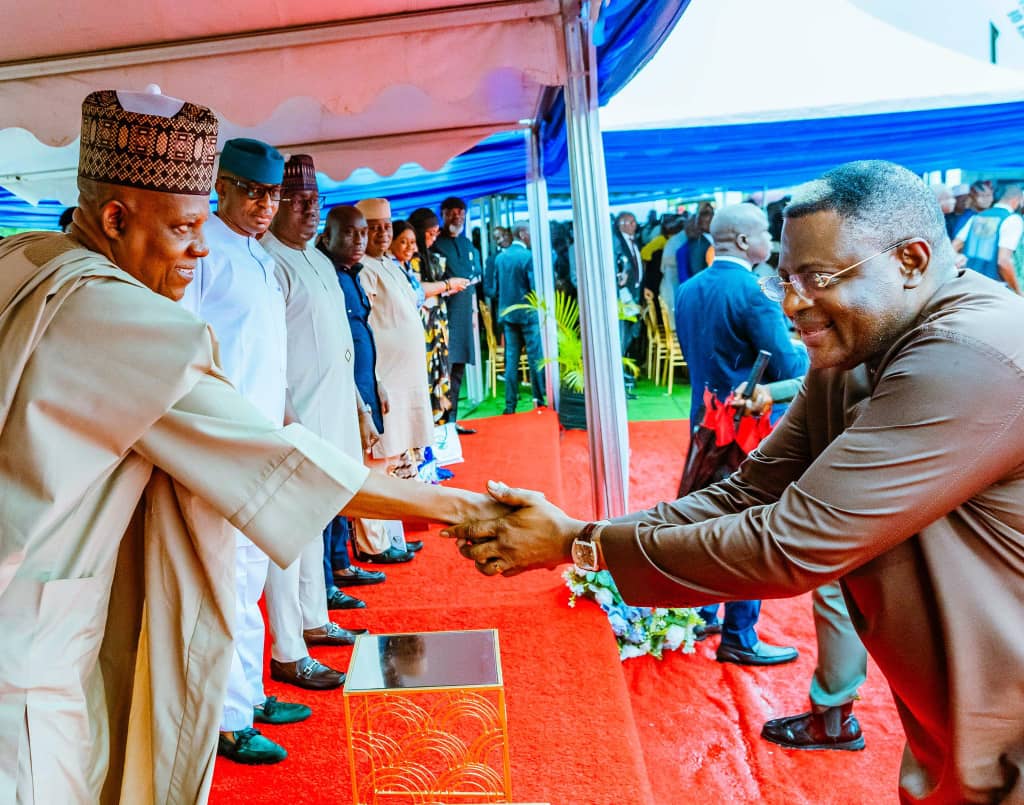
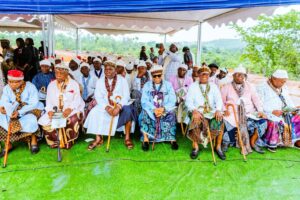
The federal government has commenced construction of the Special Agro-Industrial Processing Zone in Calabar, Cross River State, as part of a nationwide drive to transform the agricultural sector and stimulate inclusive economic growth across Nigeria.
This is the second of such a facility initiated within 72 hours after Vice President Kashim Shettima had on Tuesday performed the groundbreaking ceremony for the construction of the Kaduna State SAPZ in the Chikun local government area of the state.
Already, the AfDB_Group has reaffirmed its commitment to mobilising an additional $2.2 billion to execute the second phase of the SAPZ project across 28 states in Nigeria.
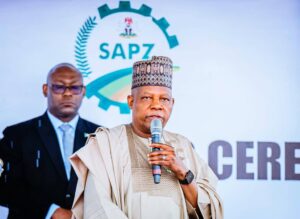
Speaking on Thursday when he performed the groundbreaking ceremony of SAPZ in Calabar, the Vice President described the project as “a game changer” that aligns with the President Tinubu administration’s Renewed Hope Agenda, aimed at diversifying the nation’s economy, addressing food security, tackling rural unemployment, as well as empowering farmers and the youth population.
“There is no intervention more practical in our dream of a nation where the potential of agriculture is maximised than what’s brought us together today. This isn’t just a project—it’s a bold vision to transform Nigeria’s agricultural value chain,” VP Shettima said.
According to him, the SAPZ initiative, supported with counterpart funding from development partners and the private sector, is designed to address challenges that have long hindered the growth of Nigeria’s agricultural economy, including inadequate processing infrastructure, limited access to markets, and rural unemployment.
“For far too long, our farmers have contended with poor infrastructure, lack of access to finance, and inadequate processing facilities. This zone is designed to confront those challenges head-on by creating an ecosystem where innovation, investment, and collaboration thrive,” he noted.
VP Shettima explained that the Calabar SAPZ will serve as a hub for agro-processing and storage, providing farmers and agripreneurs with critical infrastructure to scale their operations and tap into local and international markets.
“This is where farmers will meet with private investors, where ideas will turn into enterprise, and where our youth will find meaningful opportunities,” he said, disclosing that the Tinubu administration has classified SAPZ as a priority program in Nigeria’s quest for food security, with plans to institutionalize it as a government agency that will facilitate agricultural industrialization across all 36 states.
“These zones will generate thousands of jobs. They will create opportunities for young people, empower them with skills and knowledge to engage in meaningful work and help them contribute positively to the economy. Cross Riverians, development has come to your doorstep. For you and for the country, SAPZ is a game changer—one that will enable Nigeria to diversify its economy with a sustainable source.,” he stated.
Senator Shettima also expressed gratitude to key international development partners, including the African Development Bank, the Islamic Development Bank, and the International Fund for Agricultural Development, for their support and belief in Nigeria’s vision.
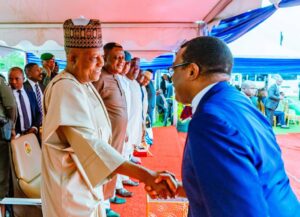
The Vice President commended Cross River State Governor, Senator Prince Bassey Edet Otu, for his collaboration, describing him as “a critical foundation for the success of this intervention and a great ally in development.”
Earlier, Cross River State Governor, Senator Otu, said the programme marked a watershed in the ongoing bid by his administration to establish the renewable resource base of the state through the full utilisation of agriculture and its multiple value chain.
Otu pointed out that in Cross River State, the establishment of a cluster of smallholder farmers in cash crops such as rice, cassava, millet, and cocoa across the state is the right step towards the agro-industrial revolution.
He said the paradigm shift from a non-renewable to a renewable resource base also holds the key to the prosperity of many nations, hence the imperative to join the league of sub-nationals in Nigeria that have adopted agriculture as the mainstay of their economy.
“The deliverables of the envisaged projects are food security, diversification of the state economy towards export-oriented trajectory and increase in the State’s GDP. When these projects are fully operational there is an expected robust collaboration with reputable agro-based processing institutes, universities and the rest, aimed at accelerating breakthroughs in many agro-industrial production.”
Also, Minister of Agriculture and Food Security, Senator Abubakar Kyari, said the programme would transform the agricultural production and agro-investment landscape in Nigeria under the Renewed Hope Agenda of President Tinubu.
Kyari thanked Vice President Shettima for his leadership and political backing at the highest level in the implementation of the SAPZ in Nigeria, just as he also commended the Governor of Cross River State for his commitment to ensuring that the state is among the front-running states that will commence the construction of their Agro-Industrial Processing Hub.
In his remark, President of AfDB, Dr Akinwumi Adesina, reiterated the bank’s pledge to mobilise $2.2 billion to execute the SAPZ project in 28 states across Nigeria.
Adesina observed that Cross River State has a significant role to play in Nigeria’s agricultural transformation because of the vast production of cocoa, cassava, rice and banana in the state, saying Obudu Cattle Ranch alone can turn the state into a huge livestock producer.
He also acknowledged that the state is ideal for SAPZ because it has an export processing zone, ports facility, and export handling capabilities, adding that the SAPZ in Calabar can easily be linked to the seaport for the transportation of processed agricultural commodities to the export market in neighbouring countries, including Cameroon and the rest.
“The African Development Bank, as you know, is spearheading this together with our partners, which include the Islamic Development Bank and the International Fund for Agricultural Development, and we have put together $934 million from the African Development Bank, with core financing of $938 million from these partners.
“The first phase of SAPZ in Nigeria will be in eight states of Cross River, Kaduna, Kano, Katsina, Oyo, Ogun, Kwara, Imo and the Federal Capital Territory. We are delighted with our partnership with the Islamic Development Bank and the International Fund for Agricultural Development.
“We have put together a financing package of $510 million to make this work. We expect, in the second phase of this, to mobilise $2.2 billion to be able to work for 28 states across the federation with several partners,” the AfDB President said.


Stanley Nkwocha
Senior Special Assistant to The President on Media & Communications
(Office of The Vice President)
10th April, 2025









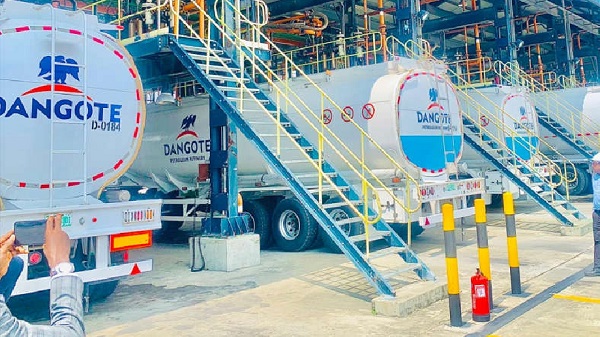
The Dangote Refinery has significantly slashed its ex-depot petrol price in a strategic move to gain a competitive edge over the Nigerian National Petroleum Company Limited (NNPC) and other petroleum marketers across the country.
According to DAILY POST checks on Petroleumpriceng on Friday morning, the refinery’s ex-depot price has dropped to N699 per litre, down from N828 per litre. This reflects a reduction of N129, representing 15.58%.
This latest review marks the 20th price adjustment by the refinery this year and comes just weeks before the busy Yuletide season.
The reduction also follows recent price cuts by the NNPC and independent filling stations, which have lowered pump prices at least twice in the last three weeks, bringing the retail cost of petrol to between N915 and N937 per litre in Abuja.

Authorities in Osun State have uncovered a major identity-theft ring after fraudsters, accused of stealing the BVN and NIN of local businesswoman Mrs. Fadahunsi Janet Gbemisola, allegedly tried to bribe her to “overlook” the compromise of her BVN.
The case has raised serious concerns over banking security, police integrity, and a nationwide data breach involving more than 150 Nigerians.
Mrs. Fadahunsi, who spoke to SaharaReporters on Monday, said the ordeal began on November 28, 2024, when she lost her phone in transit. The device contained her OPay and Palmpay SIM cards.
“I tried calling the phone, but it wasn’t picked,” she recalled. “By the following morning, it had been switched off, so I reported the matter to the police.”
Days later, she was locked out of her OPay account. According to her, Opay officials informed her that the breach originated from MoniePoint Microfinance Bank, even though she had never opened an account with the institution.
When she visited MoniePoint, staff presented her with an account profile, 8028946149, bearing her full name, BVN, NIN, and photograph. The only mismatched details were the address and phone number used to open the account.
“The officer told me I cannot deny the account because my picture and name were there,” she said. “I was shocked because I had never opened any MoniePoint account in my life.”
She later obtained a court order from the Chief Magistrate Court, Ejigbo (MEJ/M4/25) directing MoniePoint, GTBank, Opay, and Palmpay to lift restrictions placed on her BVN. Despite serving all institutions, she said MoniePoint denied ownership of the same account.
Frustrated, she went to the Central Bank of Nigeria (CBN) in Osogbo, where officials reviewed MoniePoint’s submission and confirmed that her BVN and NIN had indeed been used to open the fraudulent account.
“They showed me the form. My picture was there, my BVN was there, my NIN was there,” she said. “But the address and signature were not mine.”
According to her, CBN officials told her plainly that “until you find the person who used your identity, you cannot defend yourself.”
Confronted with the daunting task of tracking down the fraudster and with funds received from family members to bury a loved one frozen in her accounts, she sought help from the police.
Following a petition at the State Criminal Investigation Department in Osogbo, investigators traced the suspect, identified as Calistus Obi, to the Lagos–Ogun border and arrested him on March 28, 2025.
During investigation, the Police Monitoring Unit at Osogbo were able to recover from the suspect “67 SIM cards, multiple phones and evidence of over 150 identities, including BVN and NIN records, allegedly used to open MoniePoint accounts for their international syndicated fraudsters were discovered.”
During interrogation before the Osun State Commissioner of Police, Mrs. Fadahunsi said the suspect admitted he was working with a man called “Mike” based in China.
“He told the CP that he sends the MoniePoint accounts to the man in China and gets a percentage,” she narrated. “The CP asked him, ‘So you have sold Nigerian people to China because of money?’”
After his arrest, the suspect’s associates allegedly approached both the police and the victim with cash offers to bury the case.
“They called me and said I should say how much I want to forget my BVN,” Mrs. Fadahunsi said. “They offered up to ₦10 million. I refused.”
She also said an influential figure from Lagos contacted the police monitoring unit handling the case and asked them to collect ₦500,000 to release the suspect, but the officers declined.
Lamenting fraudsters in the Nigeria Police Force, she explained that shortly after rejecting the bribe, senior officers from Abuja ordered the Osun State Command to transferred the case to Force Headquarters with immediate effects.
“Unfortunately, the case file was transferred to Force Headquarters Cybercrime unit. When I got to Abuja, they told me the suspect had been released on bail,” she said.
“They suddenly claimed he was not the person who opened the MoniePoint account.”
Her new IPO reportedly told Mrs. Fadahunsi that “until we find the real person, you cannot use your BVN.”
She said investigators in Abuja dismissed the earlier evidence that linked the suspect directly to the phone number used to open the fraudulent MoniePoint account.
According to Mrs. Fadahunsi, attempts by her lawyer to follow up with police in Abuja were met with hostility.
“The IPO told my lawyer, ‘You said you want to write petition against me; go and write it,’ and he dropped the call,” she said.
She added that the released suspect later visited Osun CID, attempting to reclaim his confiscated SIM cards and phones, though Osun officers refused as at the last time she visited.
Months after court orders, petitions, and repeated visits to police and regulators, Mrs. Fadahunsi’s BVN remains blocked. Her GTBank, Opay, and Palmpay accounts are inaccessible.
“I cannot do business. I cannot even open another account,” she said. “My whole life is on hold.”
Growing Concern Over National Data Breach
The case has raised alarms about a massive BVN and NIN breach used to create fraudulent MoniePoint accounts allegedly used to receive funds from across the world.
With at least 150 Nigerians’ identities compromised, the incident signals a potential national security threat.
“This is not just my problem,” she said. “It means anyone in Nigeria can lose their identity and the system will blame them.”
When SaharaReporters contacted the Osun State Command’s spokesperson, DSP Abiodun Ojelabi Zechariah, he said he was not aware of the case but requested for the copy of the petition of the woman.
By Prince Uwalaka Chimaroke
9- DEC- 2025
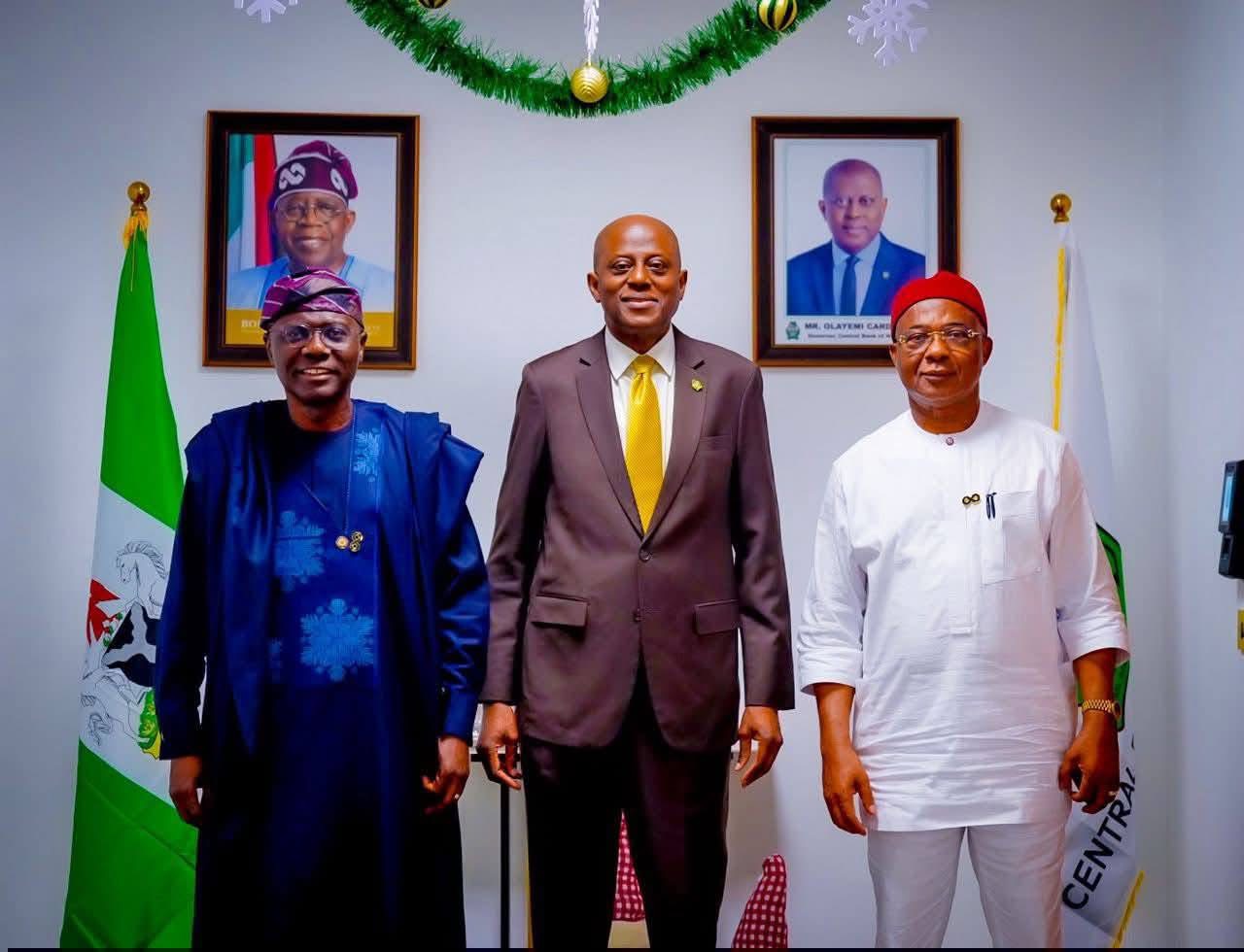
Governor Hope Uzodimma has announced that he paid an official visit to the Governor of the Central Bank of Nigeria (CBN), Mr. Olayemi Cardoso, as part of efforts to strengthen joint economic strategies aimed at improving the wellbeing of Nigerians. He was accompanied by Lagos State Governor, His Excellency Babajide Sanwo-Olu, whom he described as a brother and valued partner in national development.
During the visit, the leaders engaged in extensive discussions focused on enhancing cooperation between state governments and the apex bank. Their deliberations covered existing economic programmes currently underway across the country, with particular attention to reforms designed to support fiscal stability, promote investment, and protect the livelihoods of citizens.
Governor Uzodimma noted that the meeting also created room to explore fresh avenues for synergy on policies that can stimulate sustainable growth. The goal, he said, is to ensure that shared commitments among key government institutions are consistent with long-term national economic objectives.
He reaffirmed that such collaborations remain essential in addressing present economic challenges and securing a more prosperous future for Nigerians, emphasizing that the dialogue with the CBN Governor underscores a united resolve to deliver impactful results.
The discussion ended with all parties expressing optimism that strengthened partnerships will translate into improved outcomes for the nation’s economy.

“Forget the UK, Nigeria has everything” — IJGB man gushes over Nigeria after spending 2 days for Detty December

One of the gunmen who opened fire on innocent civilians observing Hanukkah at Bondi Beach has been identified as Naveed Akram.

During a Sunday Service Dr Chris OKAFOR have responded to Doris Ogala on why he didn’t marry her

-
Business1 year ago
US court acquits Air Peace boss, slams Mayfield $4000 fine
-

 Trending1 year ago
NYA demands release of ‘abducted’ Imo chairman, preaches good governance
-

 Politics1 year ago
Mexico’s new president causes concern just weeks before the US elections
-

 Politics1 year ago
Putin invites 20 world leaders
-

 Politics1 year ago
Russia bans imports of agro-products from Kazakhstan after refusal to join BRICS
-
Entertainment1 year ago
Bobrisky falls ill in police custody, rushed to hospital
-
Entertainment1 year ago
Bobrisky transferred from Immigration to FCID, spends night behind bars
-
Education1 year ago
GOVERNOR FUBARA APPOINTS COUNCIL MEMBERS FOR KEN SARO-WIWA POLYTECHNIC BORI