
Columns
Afghan’s claim he is 140 years old is investigated by the Taliban

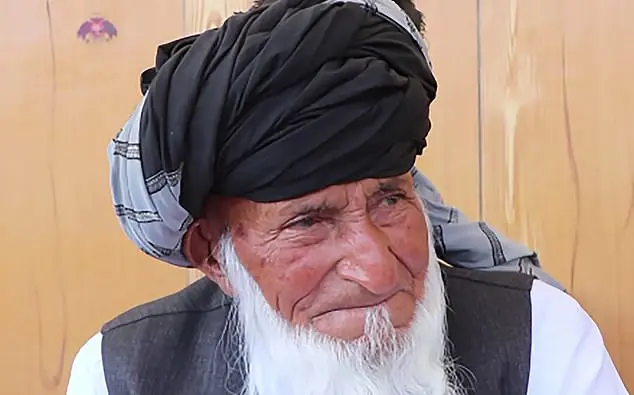
The Taliban is investigating an Afghan man’s claim that he is 140 years old – which would make him the oldest person ever to have lived.
Aqel Nazir, who lives in the country’s eastern Khost province, says he was born in the 1880s.
He claims to remember celebrating the end of the Third Anglo-Afghan War in 1919 alongside King Amanullah Khan, the Afghan leader who launched a campaign against the British, while in his thirties.
Nazir, who lives in the picturesque hills in Khost, said: ‘I was in the palace with King Amanullah Khan.
‘I was over 30 at the time and I remember saying that the British had fled and knelt down.
‘Everyone was happy and thanked King Amanullah Khan for chasing the British away.
‘Many leaders accompanied us to the Arg [presidential palace], but now all of them have passed away.’
The great-great grandfather does not have any documents to support his claim, but his family are also on board with gaining official recognition of his status.
Aqel Nazir, who lives in the country’s eastern Khost province, says he was born in the 1880s
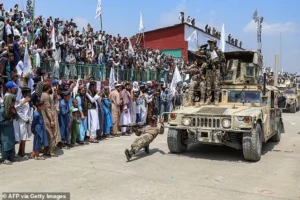
The ruling Taliban administration has dispatched a a special civil registration team to assess his true age
Khyal Wazir, his 50-year-old grandson, said: ‘He is my grandfather, and I have my grandchildren as well.’
Another grandson, Abdul Hakim Sabari, said: ‘We request the government confirm our grandfather’s age using an ID or any other scientific method or documents, to prove he is 140 years old.’
In an attempt to solve the mystery, the ruling Taliban administration has dispatched a a special civil registration team to assess his true age.
Mustaghfar Gurbaz, a Taliban spokesman for the province, said: ‘If confirmed by documents or assessments, we will work to register him as the oldest person in the world.’
If verified, he would comfortably take the title of the oldest person to have ever lived.
That record is held by Jeanne Calment, who was born in 1875 and passed away in 1997, 122 years later.
The world’s current verified oldest living person is Inah Canabarro Lucas, a Brazilian nun who turned 116 last June.
Another Brazilian woman, Deolira Gliceria Pedro da Silva, is hoping to have her own claim to be 120 years of age verified by Guinness World Records.
But experts have already cast doubt on Nazir’s claims.
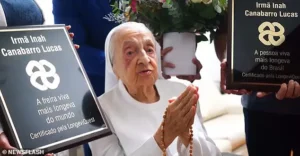
The world’s current verified oldest living person is Inah Canabarro Lucas
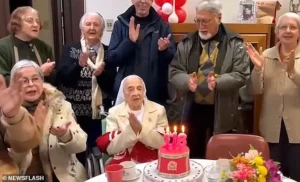
The Brazilian nun turned 116 last June
Valery Novoselov, a geriatrician at Moscow State University, told Russian outlet AIF: ‘There are no reliably registered men on the planet older than 114 to 115 years [of age].
‘In the Caucasus in the 60s, they also recorded “long-livers” – shepherds who allegedly lived to 168 years.
‘These are so-called games with age. There are no documents, no reliable data – which means this is an unrealistic picture.’
In 2015, a man claiming to be 100 years old applied for asylum in Germany after an extraordinary eight-month journey from Afghanistan.
Like Nazir, Abdul Qadir Azizi did not have any identity papers, but his family claimed his year of birth was 1905.
Azizi, who is deaf and blind, spent one month travelling across two continents from his home in the Afghan town of Baghlan to reach Germany.
His family fled after three of Azizi’s sons were killed by the Taliban.
The plight of the elderly in Afghanistan has worsened since the Taliban takeover.
In 2024, they effectively abolished the pension system, leaving many older Afghans struggling to meet basic needs.
Previously, anyone over the age of 65 received a monthly payment of around $100 from the state.





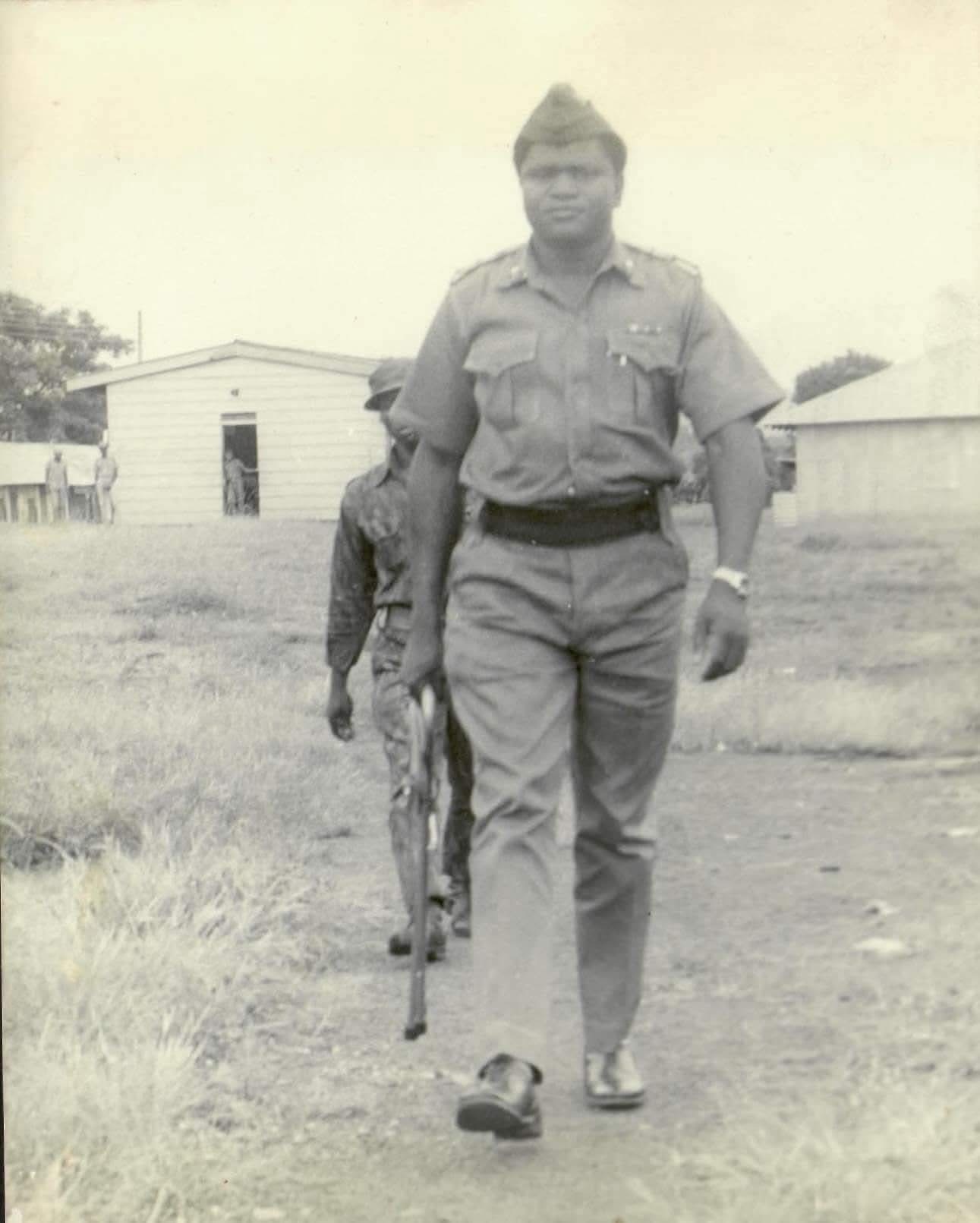
Military Governor of East Central State (1975–1976)
Colonel Anthony Aboki Ochefu was a Nigerian Army officer who played a notable role in the Nigerian Civil War and in the political transition that ended General Yakubu Gowon’s regime in 1975. He served briefly as Military Governor of East Central State from July 1975 to February 1976 during the short but transformative military government of General Murtala Ramat Mohammed.
Role During the Nigerian Civil War (1967–1970)
During the Nigerian Civil War, Colonel Ochefu commanded a battalion tasked with clearing Biafran forces from strategic riverine areas in the Mid-Western Region. His operations reportedly included the capture of Koko, Sapele, and Warri, after which his forces advanced northwards to link up with Lt. Col. Murtala Mohammed’s 2nd Division.
His battalion was later deployed as a spearhead force in the seaborne landing and capture of Creek Town, an operation that contributed to Federal control of key coastal and riverine routes. These operations placed Ochefu among officers involved in some of the more complex amphibious and riverine campaigns of the war.
Role in the 1975 Coup
By 1975, Ochefu had risen to the position of Provost Marshal of the Nigerian Army. He was one of the officers involved in planning and executing the bloodless coup of 29 July 1975, which removed General Yakubu Gowon from power.
As a Christian officer from the Middle Belt, Ochefu is credited in some accounts with helping to mobilise and coordinate Middle Belt officers in support of the coup. He reportedly played a key operational role in securing Army Headquarters at Dodan Barracks, Lagos, which was central to the success of the takeover.
Appointment as Military Governor
Following the coup, Ochefu was appointed Military Governor of East Central State, a region still recovering from the devastation of the civil war. His tenure was short-lived, lasting only a few months.
Removal from Office: Conflicting Accounts
There are conflicting historical accounts regarding the circumstances of Ochefu’s removal from office:
One account states that after the assassination of General Murtala Mohammed on 13 February 1976, the new Head of State, Lt. Gen. Olusegun Obasanjo, carried out a wide-ranging purge of senior officers. Under this version, Ochefu was among 215 officers retired or dismissed, allegedly due to issues relating to his conduct as Commanding Officer of the Lagos Garrison prior to the 1975 coup.
Alternative reports, including those referenced by Idoma Voice, claim that Ochefu was actually removed earlier by General Murtala Mohammed himself and replaced as governor by Colonel Atom Kpera.
Because official military records from this period remain incomplete or inaccessible, the exact authority and timing of his removal cannot be conclusively established.
Death
Colonel Anthony Aboki Ochefu was shot dead on 25 November 1999 at a petrol station in Oturkpo, Benue State. Publicly available sources do not provide definitive details regarding the circumstances or motive behind the killing.
Legacy
Ochefu remains a controversial but significant figure in Nigerian military history, remembered for:
His operational role during the Civil War
His involvement in the 1975 change of government
His brief governorship during a critical post-war reconstruction period
Sources
Idoma Voice (article excerpts as cited by the contributor)
Nigerian Civil War operational histories (general military records and secondary historical accounts)
Nigerian military government timelines, 1966–1979
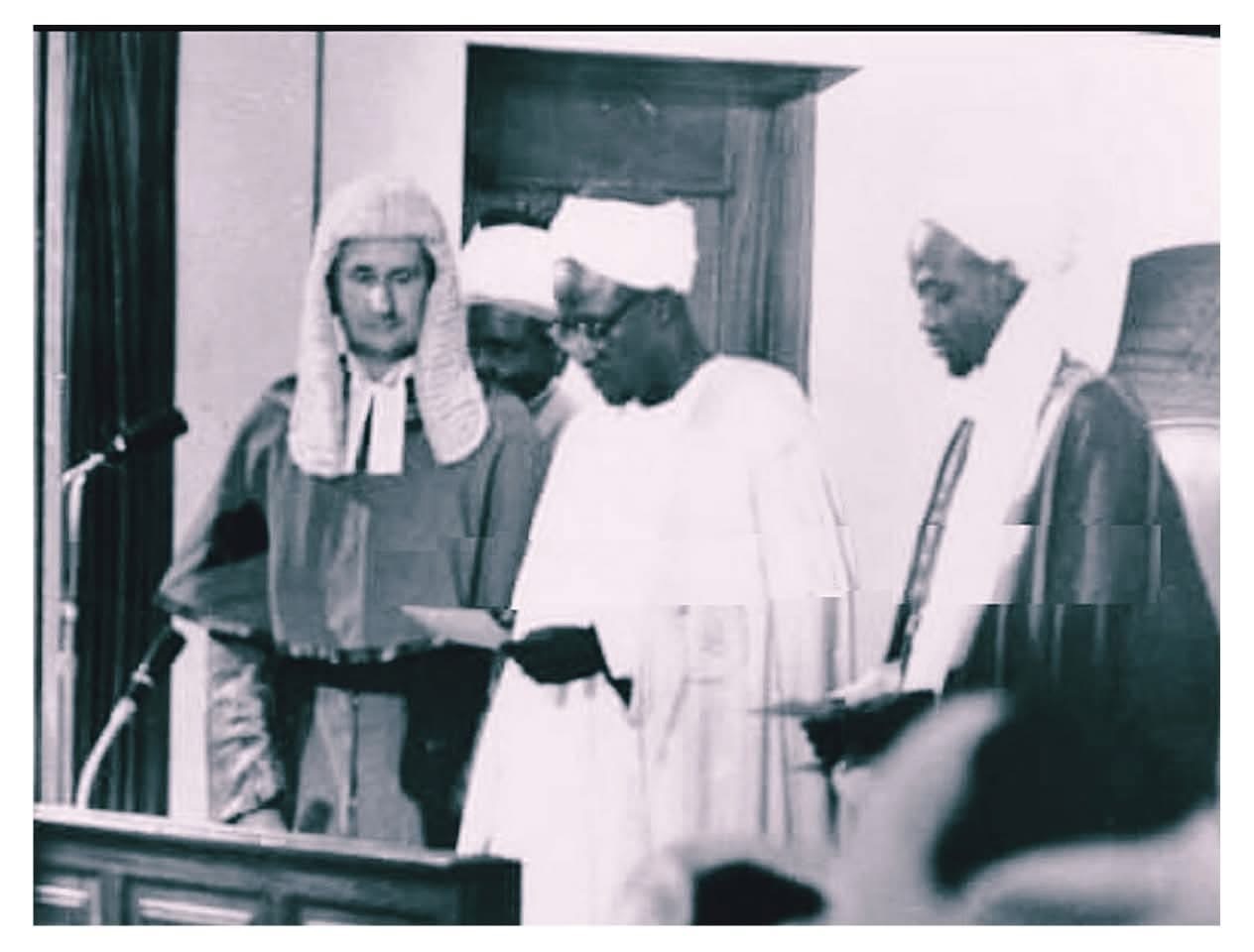
A defining moment in the transition from colonial rule to indigenous leadership in Northern Nigeria.
The image depicts Sir Kashim Ibrahim during his swearing-in ceremony as Governor of the Northern Region of Nigeria, an event that marked a significant milestone in Nigeria’s political evolution. While the photograph is often dated to the late 1950s, historical records confirm that Sir Kashim Ibrahim assumed office in October 1960, shortly after Nigeria attained independence from British colonial rule.
Sir Kashim Ibrahim was appointed Governor of the Northern Region from 1960 to 1966, becoming the first indigenous Nigerian to hold the office. His appointment symbolised the transfer of political authority from colonial administrators to Nigerians and reflected the emerging autonomy of the regions within the newly independent federation.
Born in 1909 in Maiduguri, present-day Borno State, Kashim Ibrahim was a distinguished educator, administrator, and politician. Before entering politics, he had a notable career in education, serving as Provincial Education Officer and later as Minister of Education for the Northern Region, where he played a key role in expanding access to Western education in Northern Nigeria.
The office of Governor during this period was largely ceremonial but politically significant. It represented the Crown at the regional level while reinforcing constitutional governance under Nigeria’s federal structure. As governor, Sir Kashim Ibrahim worked closely with the Northern Region’s political leadership, particularly the government of Sir Ahmadu Bello, the Sardauna of Sokoto, who served as Premier.
His tenure coincided with a formative period in Nigeria’s post-independence history, characterised by efforts at nation-building, regional development, and managing the complexities of ethnic and political diversity. Sir Kashim Ibrahim remained in office until January 1966, when Nigeria’s First Republic was overthrown following the military coup that ended civilian governance.
Beyond politics, Sir Kashim Ibrahim is remembered for his enduring contributions to education and public service in Northern Nigeria. His legacy continues through institutions named in his honour, most notably Sir Kashim Ibrahim College of Education in Maiduguri, which stands as a testament to his lifelong commitment to learning and leadership.
The photograph remains a powerful historical record, capturing a moment when Nigeria formally embraced indigenous leadership at the highest levels of regional governance.
Sources
Falola, Toyin & Matthew Heaton. A History of Nigeria. Cambridge University Press.
Coleman, James S. Nigeria: Background to Nationalism. University of California Press.
Nigerian National Archives, Kaduna – Records of Northern Regional Government (1960–1966).
Columns
Davido’s baby mama, Sophia Momodu, claps back at Snapchat user who accused her of flaunting a replica bag

Sophia Momodu has responded sharply after a Snapchat user tried to drag her over an alleged replica designer bag.
The user accused Sophia of “flaunting a replica” and warned her that this is an era where fake items are easily detected, advising her to stop “setting herself up for drags.”
Sophia was clearly not having it.
In a blunt response, she fired back, telling the user to “hold your chest and say God release me from witchcraft,” adding a sarcastic “you wish?” to shut down the allegation.
https://www.instagram.com/reel/DSMmzu8jMMN/?igsh=dDR3d2Q3ZXgxYWJu

DAVIDO DELIVERS! The king of Afrobeats surprises Carter Efe’s studio with an epic LIVE session

Engineers Farouk Ahmed, Gbenga Komolafe resign, President Tinubu nominates successors to the Senate for approval

Actress Doris Ogala reacts to Pastor Chris Okafor’s wedding, makes fresh explosive claims

-
Business1 year ago
US court acquits Air Peace boss, slams Mayfield $4000 fine
-

 Trending1 year ago
NYA demands release of ‘abducted’ Imo chairman, preaches good governance
-

 Politics1 year ago
Mexico’s new president causes concern just weeks before the US elections
-

 Politics1 year ago
Putin invites 20 world leaders
-

 Politics1 year ago
Russia bans imports of agro-products from Kazakhstan after refusal to join BRICS
-
Entertainment1 year ago
Bobrisky falls ill in police custody, rushed to hospital
-
Entertainment1 year ago
Bobrisky transferred from Immigration to FCID, spends night behind bars
-
Education1 year ago
GOVERNOR FUBARA APPOINTS COUNCIL MEMBERS FOR KEN SARO-WIWA POLYTECHNIC BORI