
Columns
Before Ajumbe Mends The Fence Of Owerri And Okigwe Zone…

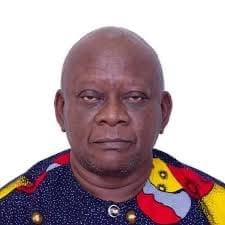
Before Ajumbe Mends The Fence Of Owerri And Okigwe Zone…
By: Ambrose Nwaogwugwu, April 08, 2024.
From the tones of newspaper headlines attributed to Chief Orikeze Vitalis Ajumbe in recent days, it seems like the Ikeduru born political contractor is out to sell out the Owerri Zone agenda again, for a few pittance.
I read a newspaper headline attributed to the Beaton Studio CEO where he was quoted as saying that only those glamoring for zoning are people who are not fit or competent enough to contest for election.
My first reaction before I searched for the entire story to read, which led me to an article with the title ‘Mending Fences And Faces The Panacea For Imo Chatter Of Equity’ published some weeks ago, precisely on the 18th day of March, was to scream — Is he out to sell us off again?
Arguing that zoning breeds mediocrity is only a clandestine ploy by the Ikeduru born political contractor to pass off some alibis to set the stage for his usual game of grand betrayal of the Owerri Zone agenda as ennounciated by the #PeoplesGovernor Hope Uzodimma for power rotation to Owerri Zone come 2027.
Arguing that charter of equity or zoning breeds incompetence or mediocrity is to say the least, uncharitable.
Our constitution, because of our peculiar diversity and discrepancies in numerical strengths, have to even design equitable distribution of our offices via the federal character provision where all components of the federation will be given a sense of belonging and this ought to be replicated in states like Imo where there are numerical imbalances.
Because I was involved:
In the political build up of the 2023 governorship election in the state. I served as the head of the state governorship campaign council on New Media and I spearheaded our party’s governorship campaigns on the New/Social Media
We traversed the nooks and crannies of the state selling the campaign manifesto of our then governorship candidate to our people and one of those manifestos was the political arrangement endorsed by the Imo State Council of elders which voted that power should rotate to Owerri Zone after the completion of the 2nd term of the #PeoplesGovernor Hope Uzodimma in 2027.
The elders of the state came to this conclusion because since the return of democracy in 1999, Owerri Zone has never become the governor of the state before.
The #PeoplesGovernor as a respecter of the elders of our state conceded to this, infact, the Governor at different fora vowed to not only implement the charter of equity as propounded by the elders of the State but will appropriate it to implement it with all the instrumentalities of the state government and power at his disposal.
We took this message to our people; both in the diaspora and at home including those at the grassroots and they bought into it, wholeheartedly.
Election came, because of the resounding performances of our then candidate in the last 3 years+ in addition to the preposition of the smooth state backed transfer of power to Owerri Zone, our people voted overwhelmingly for our party and our candidate. Something that has never happened in the state before happened and we won in all the local government areas of the state.
That was the highest vote of confidence on our performing governor and his policies including the promulgation and adoption of charter of equity which he had pledged to implement with state resources and instruments of power.
Ever since this political arrangements have been sealed, you will see enemies within who believe every election year to sell out the Owerri Zone agenda raising their ugly heads trying to cause issues where there should be none.
One of such people are the likes of Chief Ajumbe who is spreading everywhere— bad bloods, creating instigations against the proposed charter of equity all in a cunning bid to launch dereliction campaigns against the interest of Owerri Zone.
Another of his cohort is Chief Willie Amadi — this one unreasonably tries to provoke Orlu against Owerri Zone interests all in their selfish desires to sell out Owerri Zone agenda sealed by the decisions of Imo council of elders by creating fake OPOCA and all the other shenanigans (this will be a topic for another day).
We shall continue to write to expose their shenanigans so that posterity will not pass a terrible judgement of complicity on us.
Chief Ajumbe hypocritically posed in his releases as someone trying to mend fences while in actuality, he is only working for his stomach to distract Owerri Zone agenda so he can continue his political Judas Iscariotism with his intending political clients from Okigwe zone.
If truly that Chief Ajumbe means well or selfless but not selfish in his latest political marauding, why is his mending fences not proposing realistic pathways to the Owerri Zone agenda which is thru the unalloyed supports to the incumbent Governor who has already had a political understanding to transfer power to us?
You are mischievously proposing a working initiative between Owerri and Okigwe zone while you totally forgot that beyond political razzmatazz, Orlu Zone is superior, politically.
Facts are sacred as opinions are free!
The maxim that Orlu Wu Eze is not just a statement of convenience but a statement of fact! Nwaogwugwu is a realist and not one of those who deceive themselves with euphemism in their ultimate state of utopian fantasies. They have the numbers and we don’t!
We must do away with prematuris idealism and face the political realities as a people and that reality is that Owerri or Okigwe zone cannot become governor without the substantial inputs from Orlu Zone.
We must face the reality.
Good a thing you acknowledged the mathematical lopsidedness in your article with the numbers and those are the facts that matters.
How then are you going to be proposing mending fences between Owerri and Okigwe zone while totally ignoring Orlu Zone’s contribution?
Are you not setting up the Owerri Zone agenda for ultimate political massacre?
I see anyone proposing of doing away with Orlu Zone either as naive, ignorant or out to do a yoo man’s job against the Owerri Zone agenda.
While I do not think that Chief Ajumbe is naive nor ignorant, I must strongly suspect that he is out as usual to do the yoo Man’s job against the Owerri Zone agenda.
On theory and on paper, you can become governor without Orlu Zone but in practice, you are only engaging in deep slumbering and such a dreamer must wake up and stop slumbering before it’s too late.
No reasonable Owerri Zone man or woman who genuinely want power rotation to come to our zone in 2027 and not encouraging mending fences with Orlu Zone.
How can you mend fences between Owerri and Okigwe zone while you are in the court fighting Orlu Zone and tomorrow, you want to become the governor either from Owerri or Okigwe zone, is such a person not a joker?
Genuine fence mending is through consolidation of our strong base which lies in the already existing arrangements held by our elders and in respect of that, those genuinely interested must stop fighting Orlu in the court if they so desire their support tomorrow.
So, before Chief Ajumbe start fence mending between Owerri and Okigwe Zone, he must first start mending fences from Orlu Zone.
Ambrose Nwaogwugwu is an Owerri Zone Stakeholder, he wrote from Aboh Mbaise.




Columns
Chief Timothy Adeola Odutola (1902–1995): Pioneer Industrialist, Nationalist and Philanthropist of Ijebu-Ode
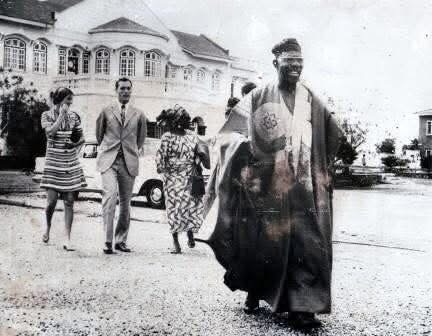
Chief Timothy Adeola Odutola was one of Nigeria’s foremost indigenous industrialists of the twentieth century, as well as a politician and philanthropist whose influence spanned commerce, nationalism, and education. Popularly known as the Ogbeni Oja of Ijebu-Ode, Odutola belonged to the pioneering generation of Nigerian entrepreneurs who laid the foundations for indigenous industrial capitalism during the colonial and early post-independence periods.
Early Life and Education
Timothy Adeola Odutola was born in 1902 in Ijebu-Ode, present-day Ogun State. He received his early education at St. Saviour’s Primary School, Italupe, and later attended Ijebu-Ode Grammar School, one of the earliest secondary schools in southwestern Nigeria. His education placed him among the emerging African elite prepared for clerical and administrative roles in the colonial system.
Early Career and Entry into Business
Odutola began his working life in the colonial service, a common pathway for educated Nigerians of his generation. However, he later resigned to pursue business independently. His early commercial ventures included trading in textiles (notably damask) and dried fish, commodities with strong local demand.
By the late 1920s and 1930s, Odutola had transitioned into the produce trade, becoming a licensed produce buyer. He invested heavily in storage facilities and transportation networks, enabling him to move agricultural products efficiently from rural areas to export points. This strategic integration helped him scale his operations rapidly.
Political Involvement and Nationalist Activities
Odutola was also politically active during the rise of Nigerian nationalism. In 1938, he served as Chairman of the Nigerian Youth Movement (NYM) in the Ijebu Division, aligning himself with one of the most influential nationalist organisations of the period.
In 1945, he represented Ijebu Province on the Legislative Council of Nigeria, the highest advisory body to the colonial government before independence. Three years later, in 1948, he was a member of the Nigerian delegation to the African Conference in London, reflecting his standing among Nigeria’s political and economic elite.
Industrial Empire and Business Achievements
By the time Nigeria attained independence in 1960, Odutola had built a large and diversified business conglomerate, making him one of the wealthiest indigenous businessmen of his era. His enterprises reportedly included:
Three industrial factories
Extensive retail and distribution franchises
A cattle ranch
A rubber and palm oil plantation covering about 5,000 acres
A sawmill
Export trading businesses
Gold exploration interests in the Ilesha area
Together with contemporaries such as Alhassan Dantata and Sir Louis Odumegwu Ojukwu, Odutola is widely regarded as part of the first generation of Nigerian industrialists who successfully competed with expatriate firms during late colonial rule.
Honours and Professional Leadership
In recognition of his contributions to commerce and public service, Odutola was awarded the Officer of the Order of the British Empire (OBE) in 1948. In the post-independence era, he became the first President of the Manufacturers Association of Nigeria (MAN), playing a central role in advocating for indigenous industrial development and protective economic policies.
Philanthropy and Legacy
Chief Odutola was also known for his extensive philanthropic activities. He funded the establishment of schools, built a church in Ijebu-Ode, and endowed professorial chairs at the University of Lagos and the University of Ibadan, contributing significantly to higher education in Nigeria.
His palatial residence, Onibudo House in Ijebu-Ode, became a symbol of indigenous wealth and success during the 1960s and 1970s and a gathering point for political and social elites.
Death and Historical Significance
Chief Timothy Adeola Odutola died in 1995, leaving behind a legacy that bridges commerce, nationalism, and philanthropy. He is remembered as a trailblazer of indigenous industrial enterprise and a key figure in Nigeria’s economic history.
Sources
Bim Babarinde Archives
Toyin Falola, Economic Reforms and Modernization in Nigeria
Manufacturers Association of Nigeria (MAN), historical records
A Milestone in Nigerian Industrial History
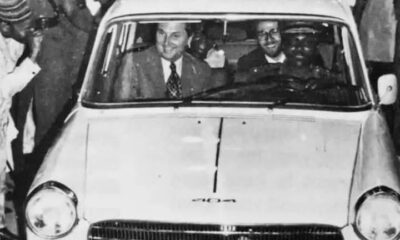
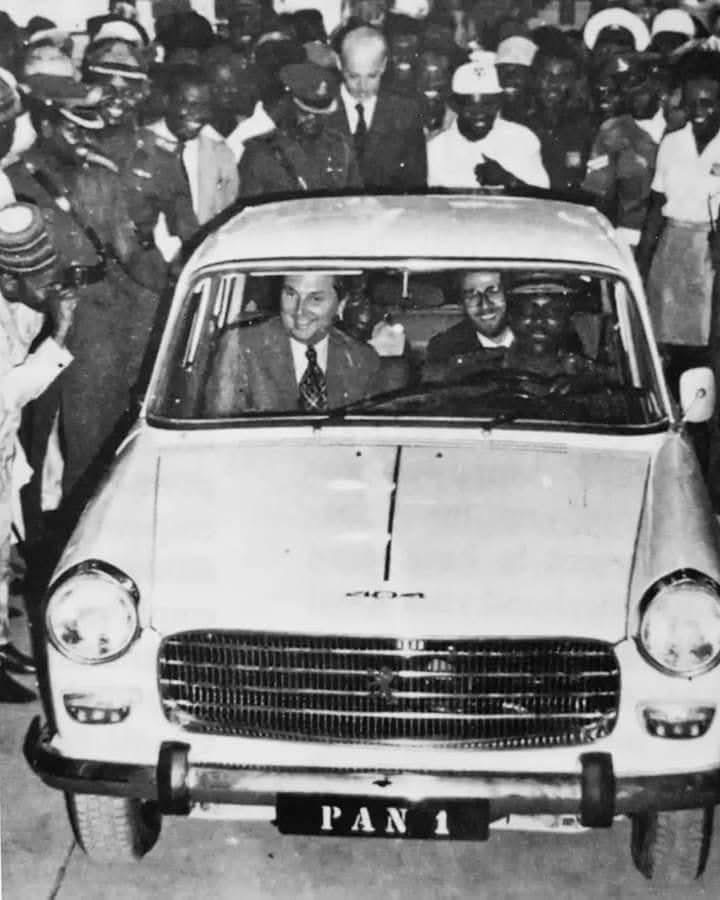
In the mid-1970s, Nigeria took a significant step toward industrial self-reliance with the establishment of Peugeot Automobile Nigeria (PAN) in Kakuri, Kaduna. One of the most symbolic moments from this period was when Nigeria’s former Head of State, General Yakubu Gowon, personally test-drove the first vehicle assembled at the PAN plant, known as PAN 1, between 1974 and 1975. The event marked a defining chapter in Nigeria’s drive toward industrialisation and indigenous manufacturing.
Peugeot Automobile Nigeria (PAN), Kakuri
Peugeot Automobile Nigeria was established as a joint venture between the Federal Government of Nigeria, Peugeot of France, and Nigerian investors. The plant in Kakuri, Kaduna State, was designed to assemble passenger vehicles locally, reduce dependence on imported cars, create skilled employment, and stimulate technology transfer.
Kaduna was chosen due to its strategic location, existing industrial base, and proximity to rail and road networks, making it a hub for northern Nigeria’s manufacturing ambitions during the oil boom years.
The PAN 1 Test Drive
The photograph capturing General Yakubu Gowon test-driving PAN 1 holds both symbolic and practical significance. PAN 1 represents the first car assembled by Peugeot Automobile Nigeria, signifying the successful commencement of operations at the Kakuri plant.
General Gowon’s participation underscored:
The federal government’s strong political backing for industrial projects
The importance attached to local manufacturing during Nigeria’s post-war reconstruction era
Confidence in Nigeria’s ability to assemble modern automobiles to international standards
The test drive occurred during a transitional phase in Nigeria’s governance, shortly before Gowon was overthrown in July 1975, making the moment historically poignant.
Industrialisation and National Pride
During the 1970s, Nigeria pursued an ambitious industrialisation agenda, buoyed by oil revenues. PAN stood alongside other major industrial projects such as Ajaokuta Steel, Volkswagen of Nigeria (VON), and the cement factories spread across the country.
The PAN initiative:
Trained Nigerian engineers and technicians
Established local supply chains
Became a symbol of modernity and national pride
Peugeot vehicles assembled in Kaduna soon became common sights on Nigerian roads and were widely adopted by government agencies and private citizens alike.
Legacy of PAN
Peugeot Automobile Nigeria remained Nigeria’s leading automobile assembly company for decades and played a central role in shaping the country’s automotive culture. Although production levels fluctuated over time due to economic challenges, policy shifts, and import competition, PAN’s historical importance remains undisputed.
The image of General Gowon behind the wheel of PAN 1 continues to serve as a visual reminder of a period when Nigeria actively pursued industrial self-sufficiency with optimism and confidence.
The test drive of PAN 1 by General Yakubu Gowon was more than a ceremonial act—it represented Nigeria’s belief in its industrial future. The moment encapsulated the aspirations of a nation eager to build, assemble, and innovate locally. Today, it stands as an enduring symbol of Nigeria’s early automotive and manufacturing ambitions.
Source
Mohammed Tukur, Facebook Photos (archival image and caption)
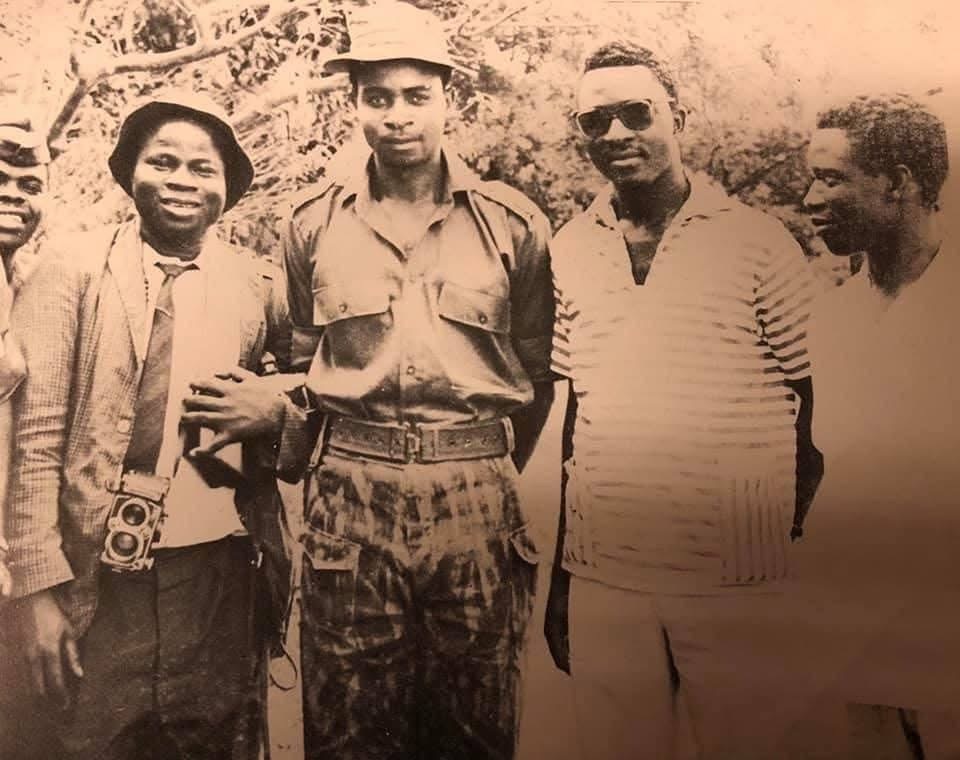
Nigerian Photojournalism, the Civil War, and a Visual Legacy
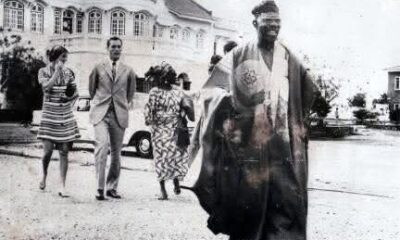
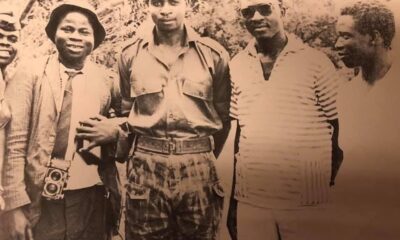
One of the most enduring visual records of the Nigerian Civil War is a photograph taken shortly after Federal troops captured Enugu in October 1967. In the image stands Peter Obe (1932–2013), one of Nigeria’s most accomplished photojournalists, alongside Lieutenant Colonel Theophilus Yakubu Danjuma and other military officers. Beyond its immediate wartime significance, the photograph symbolises the power of photography in documenting Nigeria’s most turbulent moments and preserving them for posterity.
Peter Obe: A Pioneer of Nigerian Photojournalism
Peter Obe was among the finest photographers Nigeria produced in the twentieth century. He served for many years as Chief Photographer of the Daily Times of Nigeria, then the most influential newspaper in the country. In this role, Obe documented political leaders, military campaigns, social life, and historic national events during Nigeria’s formative decades.
In addition to his work with Daily Times, Obe undertook freelance assignments for Agence France-Presse (AFP), giving his work international reach. Later, he established his own photography studio in Surulere, Lagos, a creative hub for Nigerian media professionals during the post-independence era.
The Photograph: Enugu, October 1967
The photograph featuring Peter Obe with Lt. Col. T. Y. Danjuma was taken shortly after Federal forces captured Enugu, the capital of the secessionist Eastern Region, during the Nigerian Civil War (1967–1970). The fall of Enugu marked a significant turning point in the conflict, symbolising the collapse of Biafra’s early administrative structure.
As a frontline photojournalist, Obe risked his life to document military operations, providing visual evidence of events that shaped Nigeria’s history. His work from this period remains an essential archival resource for historians studying the war.
Nigerian Photography Before and After Peter Obe
Nigerian photography predates independence by over a century. In 1859, George Da Costa established the first known portrait photography studio in Lagos, laying the foundation for indigenous photographic practice. From this early beginning emerged a lineage of photographers who shaped Nigeria’s visual culture.
Notable figures include:
Jonathan Adagogo Green of Bonny
H. Sanya Freeman
Solomon Alonge of Benin
Matthew Faji
J. D. ‘Okhai’ Ojeikere, famed for his hairstyles series
Yusuf Oladele
Jackie Phillips
Sunmi Smart-Cole
Gani Layiwola
Cornelius Oyemade
Baba Shettima
In the later twentieth and early twenty-first centuries, photographers such as Don Barber, Jide Adeniyi-Jones, and Tam Fiofori continued this tradition, blending documentary realism with artistic expression.
Peter Obe stands prominently within this continuum, bridging early post-colonial photography and modern Nigerian photojournalism.
Publication and Archival Value
Many of Peter Obe’s most important images, including the Enugu photograph, were compiled in his book:
Nigeria: A Decade of Crises in Pictures
This work remains a critical visual archive of Nigeria’s political instability, military rule, and civil conflict between the 1960s and 1970s. It is frequently cited by scholars, journalists, and curators documenting Nigeria’s modern history.
Legacy and Significance
Peter Obe’s contribution transcends aesthetics. His photographs:
Serve as primary historical evidence
Preserve moments that written records alone cannot capture
Help humanise political and military history
Through his lens, Nigerians can see their past clearly—unfiltered, immediate, and honest. His work helped establish photography as a respected tool of journalism and historical documentation in Nigeria.
The photograph of Peter Obe with Lt. Col. T. Y. Danjuma in post-capture Enugu is more than a wartime image; it is a testament to the courage of Nigerian photojournalists and the enduring value of visual history. Peter Obe’s legacy remains firmly etched into Nigeria’s collective memory, ensuring that critical moments of national crisis are neither forgotten nor distorted.
Sources
1. Obe, Peter. Nigeria: A Decade of Crises in Pictures. Lagos: Daily Times Publications, 1978.
2. Falola, Toyin. The History of Nigeria. Greenwood Press, 1999.
3. Madubuike, Uche. “Photojournalism and the Nigerian Civil War.” Journal of African Media Studies, Vol. 6, No. 2, 2014.

IMO WEST SENATOR IZUNASO WARNS AGAINST RISING TREND OF ILL-PREPARED LEADERS IN NIGERIA.

Chief Timothy Adeola Odutola (1902–1995): Pioneer Industrialist, Nationalist and Philanthropist of Ijebu-Ode

General Yakubu Gowon and Nigeria’s First Locally Assembled Peugeot

-
Business1 year ago
US court acquits Air Peace boss, slams Mayfield $4000 fine
-

 Trending1 year ago
NYA demands release of ‘abducted’ Imo chairman, preaches good governance
-

 Politics1 year ago
Mexico’s new president causes concern just weeks before the US elections
-

 Politics1 year ago
Putin invites 20 world leaders
-

 Politics1 year ago
Russia bans imports of agro-products from Kazakhstan after refusal to join BRICS
-
Entertainment1 year ago
Bobrisky falls ill in police custody, rushed to hospital
-
Entertainment1 year ago
Bobrisky transferred from Immigration to FCID, spends night behind bars
-
Education1 year ago
GOVERNOR FUBARA APPOINTS COUNCIL MEMBERS FOR KEN SARO-WIWA POLYTECHNIC BORI