
Columns
Israel’s Katz says Iran nuclear sites ‘exposed’ to strikes

Israel’s new defense minister, Israel Katz, has hinted that Israel has an “opportunity” to target Iran’s nuclear program. He has also told military officials there will be no cease-fire with Hezbollah.
Israel will continue to hit Hezbollah with “full force,” says Israel’s defense minister The UN’s humanitarian agency says Israel often denied access to northern Gaza last month Gaza medical officials say at least 14 have been killed in Israeli strikes in the Palestinian territory on Tuesday Israel’s military says four of its soldiers have died in fighting in northern Gaza
This is a roundup of the latest developments in the conflicts in the Middle East on November 12, 2024.
Iran’s nuclear sites ‘more exposed than ever,’ says Israel’s Katz
Newly appointed Israeli Defense Minister Israel Katz told military officials on Monday that Iran was “more exposed than ever to strikes on its nuclear facilities”.
“We have the opportunity to achieve our most important goal — to thwart and eliminate the existential threat to the State of Israel,” Katz added on X, formerly Twitter.
https://twitter.com/Israel_katz/status/1856076850352504875?ref_src=twsrc%5Etfw%7Ctwcamp%5Etweetembed%7Ctwterm%5E1856076850352504875%7Ctwgr%5Eeb0144dbf162d244c87aeea163c5f7488536c948%7Ctwcon%5Es1_&ref_url=https%3A%2F%2Fwww.dw.com%2Fen%2Fisrael-s-katz-says-iran-nuclear-sites-exposed-to-strikes%2Flive-70761116
According to the International Atomic Energy Agency (IAEA), Iran is rapidly advancing its nuclear program, and is continuing to increase stockpiles of uranium enriched to weapons grade levels in defiance of international demands.
IAEA head Rafael Grossi has warned that Iran possess enough uranium enriched to near- weapons-grade levels to make “several” nuclear bombs if it chose to do so.
Iran claims it’s nuclear program is for peaceful purposes.
The always tense relations between Israel and its regional archenemy have recently worsened further amid tit-for-tat missile strikes.
Iran twice fired missiles directly on Israeli territory this year, drawing responses in kind from Israel.
No cease-fire with Hezbollah: Israeli defense minister
Israel’s new defense minister, Israel Katz, says he told military officials on Monday that there would be no cease-fire in Lebanon until “the goals of the war are achieved.”
In a post on X, formerly Twitter, Katz wrote that he had told the General Defense Forum that “offensive activity should be continued in order to … realize the fruits of victory.”
“In Lebanon there will be no cease-fire and there will be no respite,” the post said.
Israeli leaders on Monday seemed to send mixed signals on the possibility of a cease-fire in Lebanon.
Foreign Minister Gideon Saar, who this week replaced Katz in the Foreign Ministry, said Israel was “working with the Americans on the issue,” reporting “a certain progress.”
Israel has escalated its hostilities against Lebanon’s Iran-backed Hezbollah militia since late September, beginning a ground offensive on September 30 after a previous campaign of intense airstrikes.
Iran-backed Hezbollah has been carrying out attacks on Israel since Israel began an offensive in Gaza against Hezbollah ally Hamas in response to deadly raids by the Palestinian militants in southern Israel on October 7, 2023.
Israeli army says 4 soldiers killed in northern Gaza
The Israeli army said on Tuesday that four of its soldiers had been killed in figthing in the northern Gaza Strip, where it has been carrying out a major offensive.
All four “fell during combat in the northern Gaza Strip” on Monday, a statement said.
The deaths bring to 376 the total number of Israeli soldiers killed in the Palestinian territory since the start of ground operations against Hamas militants in October last year.
Some 43,500 Palestinians have been killed during the campaign, according to health officials in Hamas-run Gaza. That figure does not distinguish between civilians and militants.
Israeli strikes in Gaza kill at least 14, officials say
Palestinian medical officials said two Israeli strikes in Gaza late on Monday and early on Tuesday have killed at least 14 people, including two children and a woman.
At least 11 people, including two children, died in a strike on the so-called Muwasi humanitarian zone west of Khan Younis, according to officials at Nasser Hospital.
Al-Awda Hospital officials say three people, including a woman, were killed in another strike that hit a house in Nuseirat refugee camp in central Gaza.
Israel hindering aid to northern Gaza, UN says
The UN Office for the Coordination of Humanitarian Affairs, known as OCHA, says most of its bids to coordinate aid convoys and humanitarian visits to northern Gaza last month were denied or impeded by Israel.
OCHA says it made 98 requests for authorization to enter the war-stricken zone but only 15 made it through.
A spokesperson said Ocha was “worried about the fate of Palestinians remaining in North Gaza as the siege there continues, and urgently calls on Israel to open up the area to humanitarian operations at the scale needed, given the massive needs.”
Residents of northern Gaza are at risk of acute hunger as Israel carries out a major offensive therethat it says aims to prevent Hamas militants from regrouping.




Columns
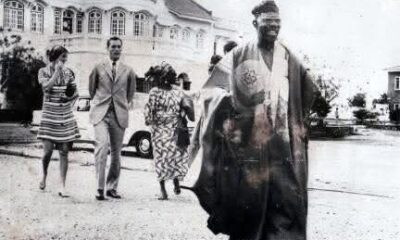
Chief Timothy Adeola Odutola (1902–1995): Pioneer Industrialist, Nationalist and Philanthropist of Ijebu-Ode
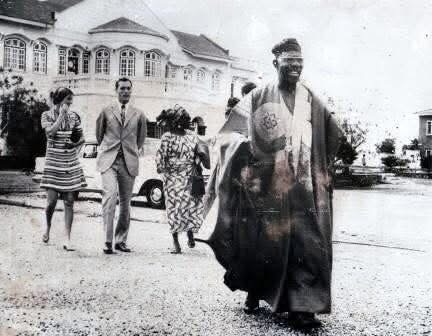
Chief Timothy Adeola Odutola was one of Nigeria’s foremost indigenous industrialists of the twentieth century, as well as a politician and philanthropist whose influence spanned commerce, nationalism, and education. Popularly known as the Ogbeni Oja of Ijebu-Ode, Odutola belonged to the pioneering generation of Nigerian entrepreneurs who laid the foundations for indigenous industrial capitalism during the colonial and early post-independence periods.
Early Life and Education
Timothy Adeola Odutola was born in 1902 in Ijebu-Ode, present-day Ogun State. He received his early education at St. Saviour’s Primary School, Italupe, and later attended Ijebu-Ode Grammar School, one of the earliest secondary schools in southwestern Nigeria. His education placed him among the emerging African elite prepared for clerical and administrative roles in the colonial system.
Early Career and Entry into Business
Odutola began his working life in the colonial service, a common pathway for educated Nigerians of his generation. However, he later resigned to pursue business independently. His early commercial ventures included trading in textiles (notably damask) and dried fish, commodities with strong local demand.
By the late 1920s and 1930s, Odutola had transitioned into the produce trade, becoming a licensed produce buyer. He invested heavily in storage facilities and transportation networks, enabling him to move agricultural products efficiently from rural areas to export points. This strategic integration helped him scale his operations rapidly.
Political Involvement and Nationalist Activities
Odutola was also politically active during the rise of Nigerian nationalism. In 1938, he served as Chairman of the Nigerian Youth Movement (NYM) in the Ijebu Division, aligning himself with one of the most influential nationalist organisations of the period.
In 1945, he represented Ijebu Province on the Legislative Council of Nigeria, the highest advisory body to the colonial government before independence. Three years later, in 1948, he was a member of the Nigerian delegation to the African Conference in London, reflecting his standing among Nigeria’s political and economic elite.
Industrial Empire and Business Achievements
By the time Nigeria attained independence in 1960, Odutola had built a large and diversified business conglomerate, making him one of the wealthiest indigenous businessmen of his era. His enterprises reportedly included:
Three industrial factories
Extensive retail and distribution franchises
A cattle ranch
A rubber and palm oil plantation covering about 5,000 acres
A sawmill
Export trading businesses
Gold exploration interests in the Ilesha area
Together with contemporaries such as Alhassan Dantata and Sir Louis Odumegwu Ojukwu, Odutola is widely regarded as part of the first generation of Nigerian industrialists who successfully competed with expatriate firms during late colonial rule.
Honours and Professional Leadership
In recognition of his contributions to commerce and public service, Odutola was awarded the Officer of the Order of the British Empire (OBE) in 1948. In the post-independence era, he became the first President of the Manufacturers Association of Nigeria (MAN), playing a central role in advocating for indigenous industrial development and protective economic policies.
Philanthropy and Legacy
Chief Odutola was also known for his extensive philanthropic activities. He funded the establishment of schools, built a church in Ijebu-Ode, and endowed professorial chairs at the University of Lagos and the University of Ibadan, contributing significantly to higher education in Nigeria.
His palatial residence, Onibudo House in Ijebu-Ode, became a symbol of indigenous wealth and success during the 1960s and 1970s and a gathering point for political and social elites.
Death and Historical Significance
Chief Timothy Adeola Odutola died in 1995, leaving behind a legacy that bridges commerce, nationalism, and philanthropy. He is remembered as a trailblazer of indigenous industrial enterprise and a key figure in Nigeria’s economic history.
Sources
Bim Babarinde Archives
Toyin Falola, Economic Reforms and Modernization in Nigeria
Manufacturers Association of Nigeria (MAN), historical records
A Milestone in Nigerian Industrial History
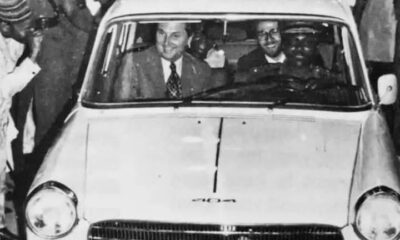
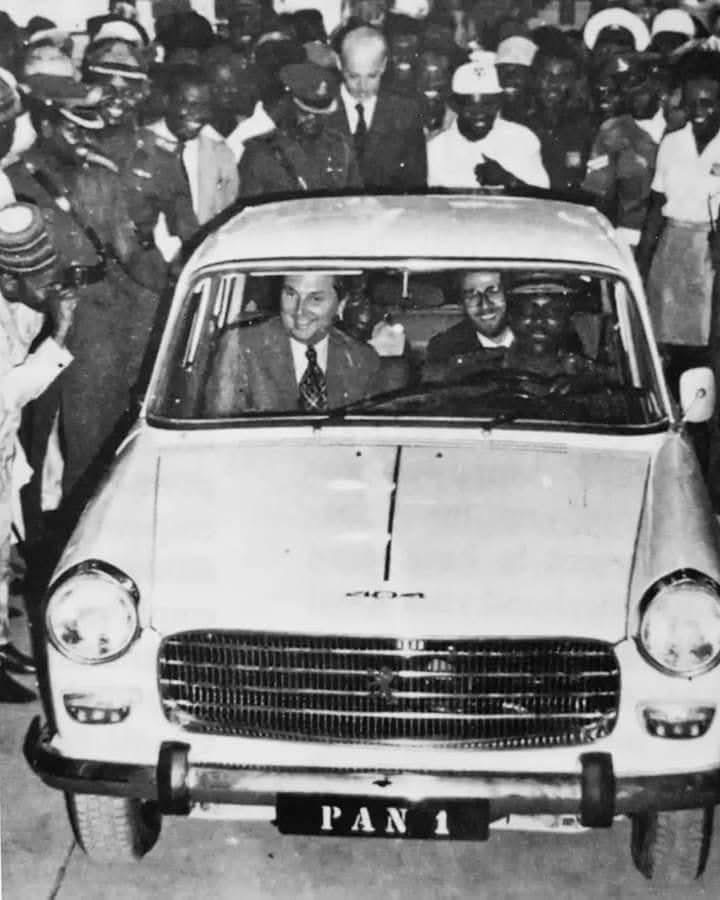
In the mid-1970s, Nigeria took a significant step toward industrial self-reliance with the establishment of Peugeot Automobile Nigeria (PAN) in Kakuri, Kaduna. One of the most symbolic moments from this period was when Nigeria’s former Head of State, General Yakubu Gowon, personally test-drove the first vehicle assembled at the PAN plant, known as PAN 1, between 1974 and 1975. The event marked a defining chapter in Nigeria’s drive toward industrialisation and indigenous manufacturing.
Peugeot Automobile Nigeria (PAN), Kakuri
Peugeot Automobile Nigeria was established as a joint venture between the Federal Government of Nigeria, Peugeot of France, and Nigerian investors. The plant in Kakuri, Kaduna State, was designed to assemble passenger vehicles locally, reduce dependence on imported cars, create skilled employment, and stimulate technology transfer.
Kaduna was chosen due to its strategic location, existing industrial base, and proximity to rail and road networks, making it a hub for northern Nigeria’s manufacturing ambitions during the oil boom years.
The PAN 1 Test Drive
The photograph capturing General Yakubu Gowon test-driving PAN 1 holds both symbolic and practical significance. PAN 1 represents the first car assembled by Peugeot Automobile Nigeria, signifying the successful commencement of operations at the Kakuri plant.
General Gowon’s participation underscored:
The federal government’s strong political backing for industrial projects
The importance attached to local manufacturing during Nigeria’s post-war reconstruction era
Confidence in Nigeria’s ability to assemble modern automobiles to international standards
The test drive occurred during a transitional phase in Nigeria’s governance, shortly before Gowon was overthrown in July 1975, making the moment historically poignant.
Industrialisation and National Pride
During the 1970s, Nigeria pursued an ambitious industrialisation agenda, buoyed by oil revenues. PAN stood alongside other major industrial projects such as Ajaokuta Steel, Volkswagen of Nigeria (VON), and the cement factories spread across the country.
The PAN initiative:
Trained Nigerian engineers and technicians
Established local supply chains
Became a symbol of modernity and national pride
Peugeot vehicles assembled in Kaduna soon became common sights on Nigerian roads and were widely adopted by government agencies and private citizens alike.
Legacy of PAN
Peugeot Automobile Nigeria remained Nigeria’s leading automobile assembly company for decades and played a central role in shaping the country’s automotive culture. Although production levels fluctuated over time due to economic challenges, policy shifts, and import competition, PAN’s historical importance remains undisputed.
The image of General Gowon behind the wheel of PAN 1 continues to serve as a visual reminder of a period when Nigeria actively pursued industrial self-sufficiency with optimism and confidence.
The test drive of PAN 1 by General Yakubu Gowon was more than a ceremonial act—it represented Nigeria’s belief in its industrial future. The moment encapsulated the aspirations of a nation eager to build, assemble, and innovate locally. Today, it stands as an enduring symbol of Nigeria’s early automotive and manufacturing ambitions.
Source
Mohammed Tukur, Facebook Photos (archival image and caption)
Nigerian Photojournalism, the Civil War, and a Visual Legacy
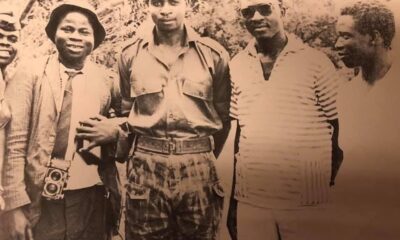
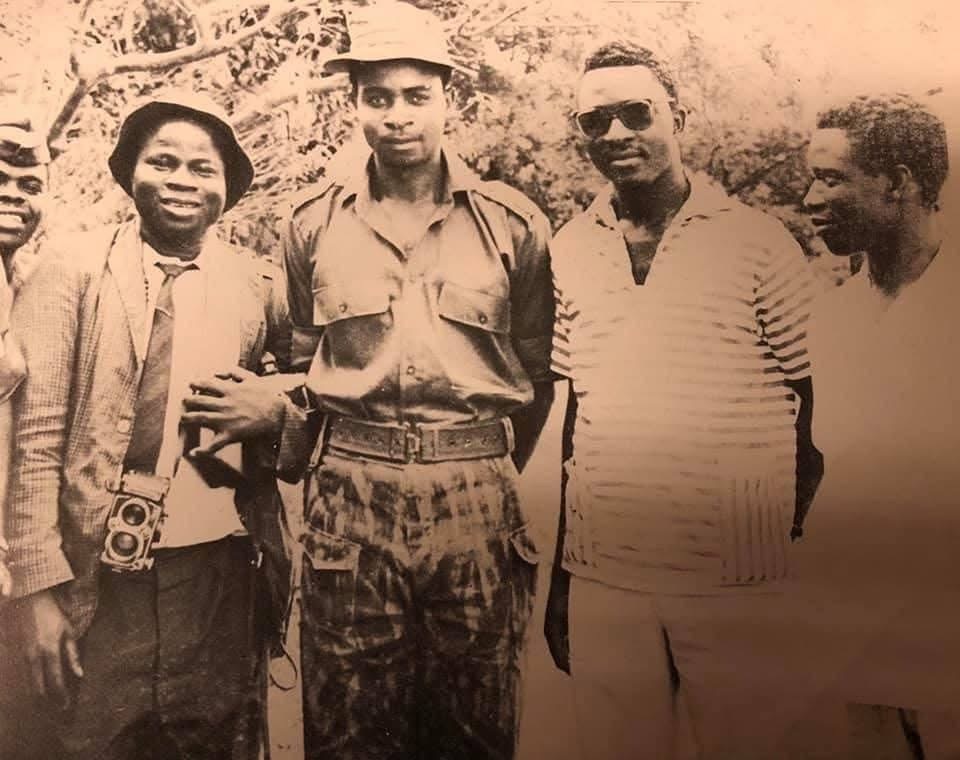
One of the most enduring visual records of the Nigerian Civil War is a photograph taken shortly after Federal troops captured Enugu in October 1967. In the image stands Peter Obe (1932–2013), one of Nigeria’s most accomplished photojournalists, alongside Lieutenant Colonel Theophilus Yakubu Danjuma and other military officers. Beyond its immediate wartime significance, the photograph symbolises the power of photography in documenting Nigeria’s most turbulent moments and preserving them for posterity.
Peter Obe: A Pioneer of Nigerian Photojournalism
Peter Obe was among the finest photographers Nigeria produced in the twentieth century. He served for many years as Chief Photographer of the Daily Times of Nigeria, then the most influential newspaper in the country. In this role, Obe documented political leaders, military campaigns, social life, and historic national events during Nigeria’s formative decades.
In addition to his work with Daily Times, Obe undertook freelance assignments for Agence France-Presse (AFP), giving his work international reach. Later, he established his own photography studio in Surulere, Lagos, a creative hub for Nigerian media professionals during the post-independence era.
The Photograph: Enugu, October 1967
The photograph featuring Peter Obe with Lt. Col. T. Y. Danjuma was taken shortly after Federal forces captured Enugu, the capital of the secessionist Eastern Region, during the Nigerian Civil War (1967–1970). The fall of Enugu marked a significant turning point in the conflict, symbolising the collapse of Biafra’s early administrative structure.
As a frontline photojournalist, Obe risked his life to document military operations, providing visual evidence of events that shaped Nigeria’s history. His work from this period remains an essential archival resource for historians studying the war.
Nigerian Photography Before and After Peter Obe
Nigerian photography predates independence by over a century. In 1859, George Da Costa established the first known portrait photography studio in Lagos, laying the foundation for indigenous photographic practice. From this early beginning emerged a lineage of photographers who shaped Nigeria’s visual culture.
Notable figures include:
Jonathan Adagogo Green of Bonny
H. Sanya Freeman
Solomon Alonge of Benin
Matthew Faji
J. D. ‘Okhai’ Ojeikere, famed for his hairstyles series
Yusuf Oladele
Jackie Phillips
Sunmi Smart-Cole
Gani Layiwola
Cornelius Oyemade
Baba Shettima
In the later twentieth and early twenty-first centuries, photographers such as Don Barber, Jide Adeniyi-Jones, and Tam Fiofori continued this tradition, blending documentary realism with artistic expression.
Peter Obe stands prominently within this continuum, bridging early post-colonial photography and modern Nigerian photojournalism.
Publication and Archival Value
Many of Peter Obe’s most important images, including the Enugu photograph, were compiled in his book:
Nigeria: A Decade of Crises in Pictures
This work remains a critical visual archive of Nigeria’s political instability, military rule, and civil conflict between the 1960s and 1970s. It is frequently cited by scholars, journalists, and curators documenting Nigeria’s modern history.
Legacy and Significance
Peter Obe’s contribution transcends aesthetics. His photographs:
Serve as primary historical evidence
Preserve moments that written records alone cannot capture
Help humanise political and military history
Through his lens, Nigerians can see their past clearly—unfiltered, immediate, and honest. His work helped establish photography as a respected tool of journalism and historical documentation in Nigeria.
The photograph of Peter Obe with Lt. Col. T. Y. Danjuma in post-capture Enugu is more than a wartime image; it is a testament to the courage of Nigerian photojournalists and the enduring value of visual history. Peter Obe’s legacy remains firmly etched into Nigeria’s collective memory, ensuring that critical moments of national crisis are neither forgotten nor distorted.
Sources
1. Obe, Peter. Nigeria: A Decade of Crises in Pictures. Lagos: Daily Times Publications, 1978.
2. Falola, Toyin. The History of Nigeria. Greenwood Press, 1999.
3. Madubuike, Uche. “Photojournalism and the Nigerian Civil War.” Journal of African Media Studies, Vol. 6, No. 2, 2014.

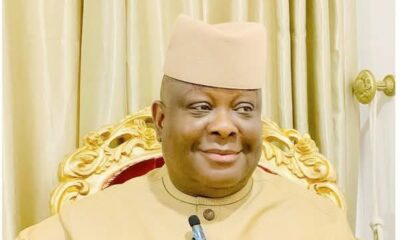
IMO WEST SENATOR IZUNASO WARNS AGAINST RISING TREND OF ILL-PREPARED LEADERS IN NIGERIA.

Chief Timothy Adeola Odutola (1902–1995): Pioneer Industrialist, Nationalist and Philanthropist of Ijebu-Ode

General Yakubu Gowon and Nigeria’s First Locally Assembled Peugeot

-
Business1 year ago
US court acquits Air Peace boss, slams Mayfield $4000 fine
-
 Trending1 year ago
NYA demands release of ‘abducted’ Imo chairman, preaches good governance
-

 Politics1 year ago
Mexico’s new president causes concern just weeks before the US elections
-
 Politics1 year ago
Putin invites 20 world leaders
-
 Politics1 year ago
Russia bans imports of agro-products from Kazakhstan after refusal to join BRICS
-
Entertainment1 year ago
Bobrisky falls ill in police custody, rushed to hospital
-
Entertainment1 year ago
Bobrisky transferred from Immigration to FCID, spends night behind bars
-
Education1 year ago
GOVERNOR FUBARA APPOINTS COUNCIL MEMBERS FOR KEN SARO-WIWA POLYTECHNIC BORI