
Education
Student loan does not restrict travel or job opportunities abroad- NELFUND

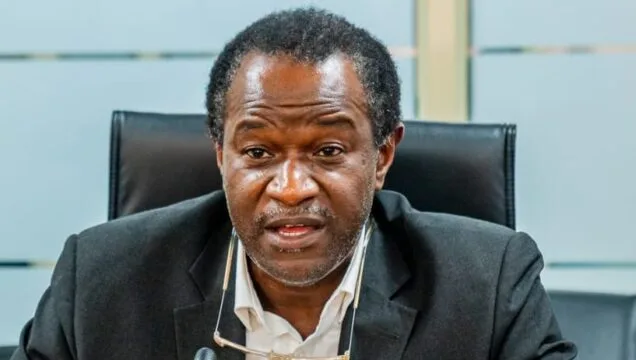
The Nigerian Education Loan Fund (NELFUND) has assured students that beneficiaries of the student loan scheme will not be restricted from travelling abroad after graduation.
Managing Director and Chief Executive of NELFUND, Akintunde Sawyerr, made this clarification during a sensitization programme at Edo University, Iyamho, while addressing students’ concerns about potential travel limitations.
Sawyerr emphasized that the law establishing NELFUND does not impose any travel restrictions on beneficiaries.
However, he advised that students should take responsibility for repaying their loans, even if they secure jobs outside Nigeria.
“I think the right and proper thing to do, if you have a loan in Nigeria and you want to get a job somewhere else, is to pay the loan yourself back to your country,” he added.
Interest-free repayment structure
Sawyerr encouraged students to embrace the scheme, highlighting its unique benefits compared to other loan types.
“I want you to embrace it and I want you to act upon it because, if you miss this opportunity, it’s one that will affect generations… You know why? Because NELFUND is different from all other types of loans. It is the only loan you can take to acquire something that can never be taken away from you,” he explained.
- According to him, the repayment structure is interest-free, even if repayments extend over a decade.
- Sawyerr also provided updates on the disbursement process, revealing that NELFUND is prepared to distribute N135 billion once all applications are processed.
“We have received about 520,000 registrations and about 419,000 applications. We have processed and paid 261,000 students. Both upkeep and institutional fees. Our total exposure today, if we were to pay everybody that has applied, is somewhere in the region of N135 billion. But we have not processed all those people. We have got the money and we are ready in case all of them get processed. We can disburse N135 billion,” he disclosed.
University officials commend initiative
Acting Vice Chancellor of Edo University, Professor Dawood Egbefo, applauded the initiative, noting that 51 students from the institution had already benefited from N61.4 million in funding during the 2023/2024 academic session.
During an earlier sensitization visit to Ambrose Alli University, Ekpoma, NELFUND expressed concern over low application numbers, revealing that only 102 students had applied, amounting to less than N20 million in disbursements.
Lami Suwaid, Director of Loan Allocation and Distribution at NELFUND, encouraged the university to take advantage of the new registration cycle to boost participation.










The Federal Government has announced a nationwide ban on the admission and transfer of students into Senior Secondary School Three (SS3) in all public and private schools, beginning from the 2026/27 academic session.
The announcement, signed by Boriowo Folasade, Director of Press and Public Relations at the Federal Ministry of Education, said the directive was part of efforts to curb examination malpractice and restore credibility to Nigeria’s education system.
“The Federal Government, through the Federal Ministry of Education, has announced a nationwide prohibition on the admission and transfer of students into Senior Secondary School Three (SS3) in all public and private secondary schools,” the statement read.
According to the ministry, the policy follows growing concerns over the increasing incidence of malpractice, including the use of so‑called special centres during external examinations.
It explained that admissions and transfers will now be restricted strictly to Senior Secondary School One (SS1) and Senior Secondary School Two (SS2). “Admission or transfer into SS3 will no longer be permitted under any circumstance,” the ministry stated.
Officials said the measure is aimed at discouraging last‑minute movement of students for examination‑related advantages, ensuring proper academic monitoring, and promoting continuity in teaching and learning.
School proprietors, principals, and administrators nationwide have been directed to comply fully with the policy.
The ministry warned that any violation would attract sanctions in line with existing education regulations and guidelines.
Reaffirming government’s commitment, the statement added: “The Federal Ministry of Education reaffirms the Federal Government’s commitment to maintaining academic standards, promoting fairness, and restoring credibility to public examinations across the country.”
Education
How Fulani Militias Attacked Taraba Community, K!lled My Father, Four Relatives — Grieving NYSC Member Cries Out (Video)

Orkeghen Philip Aondofa, a serving member of the National Youth Service Corps (NYSC), has cried out for help, alleging that armed Fulani herders carried out a de@dly attack on his village — New-Gboko (Nyugoko) in the Peva–Chanchanji Ward of Takum Local Government Area, Taraba State.
They reportedly k!lled his father and four other members of his family.
Philip, who is currently serving in Enugu State, recounted the horror in an emotional interview with SaharaReporters, saying the Taraba State government has remained silent while k!llings continue across communities in Chanchanji ward.
According to him, the attackers, whom he repeatedly referred to as “herders ”, invaded the community on November 27, 2025, unleashing violence that forced all surviving residents to flee.
He said the assailants are still occupying the village, preventing him from retrieving his father’s corpse for burial.
“Right now, as I speak to you, the k!lling is all over Chanchanji ward in Takum LGA of Taraba State. The Taraba State Government is silent about it,” he said.
The corps member said one of the attackers used his late father’s phone to call him after the massacre — only to confess to k!lling him.
“After the attack, one of them took my father’s phone and called me. When I asked where the owner of the phone was, he told me, he k!lled my father directly. I broke down and ended the call,” he said.
Philip said the inability to recover his father’s remains has left him in deeper anguish.
“What pains me the most now is how I will get my father’s corpse to bury. Those herders are still there in the village. There is nobody left in my village.”
The corps member said he is nearing the end of his service year but now feels completely stranded and without hope.
“After my service, I don’t know where to go. I don’t know where to start. I am calling on the Federal Government and those concerned to come to my aid. I am broke, I am hopeless. I don’t have anywhere to go; everything is gone. I have lost hope.”

The Tertiary Education Trust Fund (TETFund) has announced a major initiative to strengthen security across universities, polytechnics, and colleges of education in Nigeria. As part of the new move, the Fund is developing a comprehensive security master plan aimed at addressing the growing threats facing campuses nationwide.
According to the Chairman of the Board of Trustees, the framework will serve as a unified guide for preventing, managing, and responding to security breaches within tertiary institutions. He noted that the rising cases of attacks, kidnappings, and other safety concerns have made it imperative to adopt a coordinated national approach to protect students, staff, and infrastructure.
The proposed security master plan is expected to involve collaboration with security agencies, education stakeholders, and institution managers to ensure effective implementation across the country.

The man who tackled a gunman to the floor and saved people from getting sh0t at Bondi Beach in Australia has been identified as Ahmed al Ahmed.

John Cena Retires From Wrestling (Video)

Female Student Missing For 8 Days Found Chilling At Boyfriend’s House

-
Business1 year ago
US court acquits Air Peace boss, slams Mayfield $4000 fine
-

 Trending1 year ago
NYA demands release of ‘abducted’ Imo chairman, preaches good governance
-

 Politics1 year ago
Mexico’s new president causes concern just weeks before the US elections
-

 Politics1 year ago
Putin invites 20 world leaders
-

 Politics1 year ago
Russia bans imports of agro-products from Kazakhstan after refusal to join BRICS
-
Entertainment1 year ago
Bobrisky falls ill in police custody, rushed to hospital
-
Entertainment1 year ago
Bobrisky transferred from Immigration to FCID, spends night behind bars
-
Education1 year ago
GOVERNOR FUBARA APPOINTS COUNCIL MEMBERS FOR KEN SARO-WIWA POLYTECHNIC BORI