
Tech
Top secret lab is developing the UK’s first quantum clock

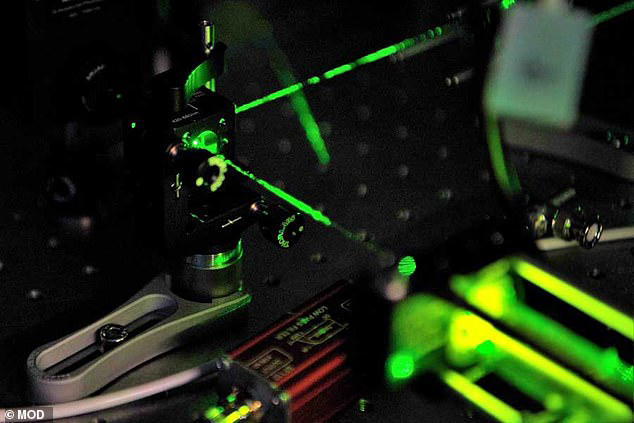
- READ MORE: Google’s quantum chip can perform ‘impossible’ tasks in five mins
A top secret lab is developing a super-precise ‘quantum clock’ that could revolutionize British intelligence.
This super-accurate timekeeping device, to be rolled out by 2029, will allow more precise navigation and surveillance on Royal Navy ships and RAF planes.
It will also ‘enhance the accuracy of advanced weapons’ like guided missiles and give British computer boffins the edge over online adversaries like cyber criminals.
The clock’s precision will be so refined that it will lose less than one second over billions of years, allowing scientists to measure time at an unprecedented scale.
It is the first device of its kind to be built in the UK and will be deployable on military operations in the next five years, according to Defence Science and Technology Laboratory (DSTL).
‘This first trial of advanced atomic clock represents a significant achievement in the UK’s quantum technology capabilities,’ said DSTL chief executive Paul Hollinshead.
‘The data gathered will not only shape future defence effort but is also a signal to industry and academia that we are serious about exploring quantum technologies for secure and resilient operational advantage.’
Quantum clocks use quantum mechanics – the physics of matter and energy at the atomic and subatomic scale – to keep time with unprecedented accuracy by measuring energy fluctuations within atoms.
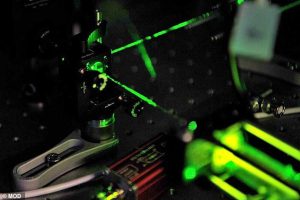
Developed at the top-secret Defence Science and Technology Laboratory, (Dstl) the quantum clock will improve British intelligence and surveillance by decreasing the reliance on GPS technology, which can be disrupted and blocked by adversaries

To be rolled out by 2029, the quantum clock will allow more precise navigation and surveillance on Royal Navy ships and RAF planes. Pictured, Royal Navy Duke class Type 23 anti-submarine frigate HMS Portland
Quantum clocks are even more accurate that the ‘atomic clocks’, of which there are approximately 400 already in operation around the world.
The UK already has an atomic clock at the National Physical Laboratory in London, but this quantum clock will be the country’s first.
Nick France, CTO of Sectigo, told MailOnline: ‘A quantum clock is a type of atomic clock – essentially a super-accurate timekeeping device.
‘Atomic clocks work by measuring the resonant frequency of atoms, whereas quantum clocks measure very small energy changes (‘quantum fluctuations’) in these atoms, leading to increased accuracy even over super-accurate atomic clocks.
‘Atomic clocks currently are incredibly accurate anyway, but a quantum clock has accuracy levels where only a single second is lost in billions of years of operation.’
The British quantum clock will be ‘the first device of its kind to be built in the UK’, said the UK government in a statement, but it will not be a world first.
Back in 2010, the University of Colorado at Boulder developed a quantum clock with the US National Institute of Standards and Technology.
However, key barriers to deploying quantum clocks are their size – current models come in a van or in a car trailer and are about 1,500 litres in volume.
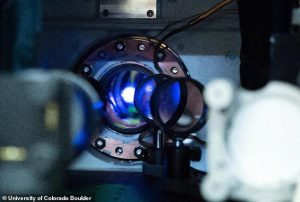
Atomic clocks use certain resonance frequencies of atoms to keep time with extreme accuracy. Pictured, atomic clock at the University of Colorado Boulder in the US
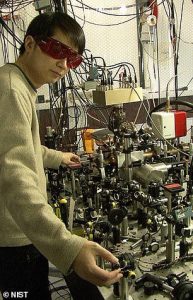
Back in 2010, the University of Colorado at Boulder developed a quantum clock with the US National Institute of Standards and Technology (pictured)
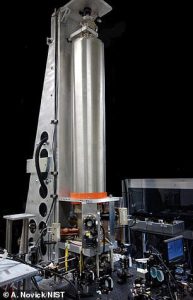
Pictured, NIST-F1, source of the official time of the USA
Just like most quantum equipment, quantum also have sensitivity to environmental factors such as heat and air molecules, limiting their transport between different places.
‘Quantum clocks are not small like watches or alarm clocks,’ France added.
‘These are devices that in current implementations can be large, even room-sized devices.
‘However, improvements in technology will decrease the size of these devices making them more portable.’
Apart from just ultra-precise timekeeping, quantum clocks could transform global navigation systems by helping satellite communications and aircraft navigation.
According to DSTL, their quantum clock will enable more precise and independent navigation systems, reducing reliance on GPS satellites, which are vulnerable to jamming or destruction in conflict scenarios.
It will improve communications systems, such as encrypted military networks, which depend on highly synchronised timekeeping, as well as boosting the accuracy of advanced weapon systems like guided missiles, which rely on accurate timing to calculate trajectories and coordinate attacks.
What’s more, British Armed Forces will get an edge over adversaries in ‘timing-critical operations’, such as cyber warfare, where milliseconds can make a difference.
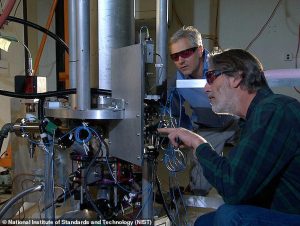
Coordinated Universal Time (UTC) is defined by sophisticated, ultra-precise ‘atomic clocks’ around the world, which tick precisely and continuously. Experts are pictured here with the NIST-F2 atomic clock in the US
Cyber warfare refers to the actions by a nation-state or international organization to attack and attempt to damage another nation’s computers or information networks.
France told MailOnline: ‘Super-accurate timekeeping is important to governments and militaries to enable accurate navigation (using GPS or similar technologies) of planes and ships, but also guidance of weapons systems such as missiles.
‘Equally important to the military as well as civilians is secure communications.
‘Much of the secure communications for governments and the military relies on accurate time sources to function.
‘But equally these accurate clocks are useful for more civilian applications and general internet security, even securing your personal data as it’s transmitted around the internet.’
Companies and governments around the world are keen to cash in on the huge potential benefits that the spooky effects of quantum technology could bring.
Google last month unveiled a new quantum computing chip it said could do in minutes what it would take leading supercomputers 10 septillion years to complete.
Eventually, such a chip could power a ‘commercial’ quantum computer that could be purchased by members of the public and used in labs, offices and even homes.
These ultra-powerful machines, which use the spooky effects of quantum physics, could do everything from speed up AI, solve climate changeand discover lifesaving drugs.









Tech
“I Lost $1.2 Million To Hackers On One Of My Apps. I Caught One Of The Hackers, And Instead Of Handing Him Over To The Police, I Employed Him To Work For Me.”- BLord

Anambra Born tech entrepreneur and businessman Linus Williams, popularly known as BLord, has shared an unusual story about how he handled a major cyberattack on one of his applications.
According to BLord, he lost $1.2 million to hackers who infiltrated one of his digital platforms. In the course of tracking the incident, he successfully identified one of the individuals involved in the breach.
Rather than handing the suspect over to security agencies, BLord said he made a strategic decision: he employed the hacker.
He explained that the hacker’s skills, though misapplied, were exceptional and could be redirected towards strengthening his company’s cybersecurity systems.
BLord noted that the decision was driven by a desire to turn a negative experience into an opportunity for growth and to better secure his business infrastructure.

The MD/CEO of John Zobis Group, Mr. John Ezeobi, has again been honoured with another major industry prize in recognition of his contributions to local sourcing, innovation and the growth of Nigeria’s manufacturing capacity.
The prestigious award, “Pillar of Industrial Enterprise and National Impact,” which was conferred on him by the Manufacturers Association of Nigeria (MAN) — Anambra, Ebonyi and Enugu Zone, was presented during the association’s 37th Annual General Meeting, Awards & Gala Night at the International Conference Centre, Enugu.
coming barely three weeks after Ezeobi was nominated as the winner of The Sun’s Industrialist of the Year Award 2025 by the Management of The Sun Newspaper, a run of recognition that has further highlighted his rising profile in the South-East manufacturing ecosystem.
The latest award, it was gathered, celebrates Ezeobi’s deliberate investment in backward integration, his push for local sourcing of raw materials and efforts to strengthen domestic value chains, which MAN described as essential to reducing import dependence and creating jobs across the region.
Chaired by Chief Obinna Iyiegbu (Obi Cubana), the well-attended occasion, themed “Exploring Opportunities for Backward Integration and Local Sourcing of Raw Materials for the Manufacturing Sector,” brought together regulators, policymakers, manufacturers and industry stakeholders and also featured presentations, panel sessions and cultural performances, among other highlights.
Speaking at the event, the Keynote Speaker and Director-General of the Raw Materials Research and Development Council (RMRDC), Prof. Nnanyelugo Ike-Muonso, said the economic benefits of exploring Opportunities for backward integration and local sourcing of raw materials for the Manufacturing sector cannot be overemphasized.
Prof. Ike-Muonso told delegates that Nigeria spent over ₦3.53 trillion importing raw materials in the first half of 2025 alone, warning that such dependence continues to weaken the nation’s economy. He further argued that the proposed 30% Value Addition Bill, which would require a minimum local value addition before export, would be transformational if signed into law.
He also outlined the bill’s potential to expand GDP, generate hundreds of thousands of jobs and save foreign exchange by keeping more of the country’s raw-material wealth in domestic supply chains, boost local manufacturing, and generally reposition Nigeria as a regional industrial hub.
On his own part, the Governor of Enugu State, Dr. Peter Mbah, endorsed the call for stronger industry-academia partnerships and urged financial institutions to make affordable credit available to manufacturers who adopt backward integration. The governor, who was represented by his Deputy, Barrister Ifeanyi Ossai, described the policy pathway as key to moving Nigeria from resource export dependence toward higher-value industrial output.
Reacting via his social handle shortly after receiving the award, the Zobis Cable Boss expressed gratitude for the honour, describing it as a strong motivation to do more in driving local production, reducing import dependence, and strengthening Nigeria’s industrial base.
Ezeobi, who received the plaque from pioneer Nollywood star and legal practitioner, Barr. Kenneth Okonkwo, attested that the AGM provided a critical platform for renewed commitment to backward integration as a pathway to sustainable industrial development.
“The event highlighted the critical importance of backward integration and local sourcing of raw materials as strategic levers for strengthening domestic production, reducing import dependency, and building resilient, self-sustaining industries. A meaningful platform for driving progress and collaboration across Nigeria’s manufacturing sector,” he partly wrote.
Also speaking, the Chairman of MAN for the Anambra-Ebonyi-Enugu zone, Dr. Adaora Chukwudozie, described local sourcing as the pragmatic route to lowering production costs and stabilizing supply chains for SMEs and larger manufacturers alike. She welcomed RMRDC’s roadmap and invited state governments to partner in establishing raw-material corridors and shared processing facilities that would bring inputs closer to factories.
The event, which had His Eminence, Eze Eberechukwu Orji, Eze Aro, as the Royal Father of the Day, was also graced by other notable dignitaries and stakeholders, which include Senator Osita Izunaso, Dr. Gideon Chidiebere Osi, Ichie Sunday Ezeobiora , Chairman, Sunchi Farms; Mr Linus Williams Ifejika, Chairman Blord Group; Otumba Francis Meshioye, National President, Manufacturers Association of Nigeria; Dr. Ifeanyi Okoye, Chairman, Juhel Pharmacy; Chief Dr. Dan Chukwudozie, Chairman,Dozzy Group; Dr. Chike Obidigbo,Chairman, Hardis and Dromedas; Anambra Commissioner for Trade and Industry,Mr. Christian Udechukwu.














Tech
GLOBACOM SEALS STRATEGIC CONNECTIVITY PARTNERSHIP TO DRIVE IMO STATE’S DIGITAL TRANSFORMATION AGENDA

By Prince Uwalaka Chimaroke
15-NOV-2025
Globacom, one of Nigeria’s leading digital solutions providers, has entered into a groundbreaking Internet connectivity agreement with the Imo State Government through the Ministry of Digital Economy and e-Governance—an ambitious step that signals the state’s commitment to becoming a fully digitized economy and a model Smart City in the South-East.
The agreement, hailed as the largest single fixed Internet connectivity initiative ever undertaken by Globacom’s Enterprise Business Group, underscores the company’s growing influence in deploying world-class telecommunications infrastructure across Nigeria. This milestone partnership positions the operator at the heart of Imo State’s fast-evolving digital future.
Through the deal, Globacom will deliver high-capacity, state-of-the-art Internet infrastructure to strategic government and institutional locations. These include the 15-building Smart City complex in Owerri, the Ministry of Digital Economy and e-Governance, and the Imo State University for Innovation, Science and Technology (formerly Imo State Polytechnic). The infrastructure rollout is expected to strengthen digital literacy, modernize public administration, and enhance access to digital services for residents.
A central component of the project is the integration of the Glo-1 submarine cable—Globacom’s privately owned, trans-Atlantic fibre optic system that links Nigeria directly to Europe. Known for its high bandwidth, ultra-low latency, and secure connectivity, the Glo-1 network will serve as the backbone for Imo State’s digital expansion.
With this partnership, Imo State aims to accelerate e-governance, improve the efficiency of public service delivery, attract technology-driven investments, and promote innovation across sectors including education, commerce, and security.
The collaboration demonstrates a shared vision between the State Government and Globacom: to empower citizens, institutions, and businesses through robust digital infrastructure that can sustain long-term economic growth.

FG Bans Admission, Transfer Of SS3 Students

“It took me getting married and giving birth to realise marriage benefits men more” — Woman shares emotional thoughts

Private jet crash lands at Kano airport

-
Business1 year ago
US court acquits Air Peace boss, slams Mayfield $4000 fine
-

 Trending1 year ago
NYA demands release of ‘abducted’ Imo chairman, preaches good governance
-

 Politics1 year ago
Mexico’s new president causes concern just weeks before the US elections
-

 Politics1 year ago
Putin invites 20 world leaders
-

 Politics1 year ago
Russia bans imports of agro-products from Kazakhstan after refusal to join BRICS
-
Entertainment1 year ago
Bobrisky falls ill in police custody, rushed to hospital
-
Entertainment1 year ago
Bobrisky transferred from Immigration to FCID, spends night behind bars
-
Education1 year ago
GOVERNOR FUBARA APPOINTS COUNCIL MEMBERS FOR KEN SARO-WIWA POLYTECHNIC BORI